Website Design for Therapists: What a Private Practice Site Needs
What a therapist's website needs to show someone before they reach out, page by page: who you help, fees and insurance, a gentle first step and a short contact form. Then how to build one by asking Claude.

Usman Haider
Website design for therapists starts with one person, on their phone, late at night. They have finally decided to look for help. Before they reach out, they want answers to a few quiet questions. Do you help with what I'm going through? Will I feel safe with you? What will it cost? What happens if I get in touch?
A good practice site answers those questions plainly and kindly. This guide lists what it needs, page by page. It is useful whatever you build with. Then it shows how I built one for a made-up therapist by asking Claude. A later change took one sentence.
What people check before they reach out
Reaching out to a therapist is hard. Many visitors leave before they do it. The first screen should make the next step feel small.
It should say four things:
- Who you are: your name and license, such as "Licensed Marriage and Family Therapist".
- Who you help: the concerns you work with, in plain words. "Anxiety, grief and couples counseling" beats "holistic healing".
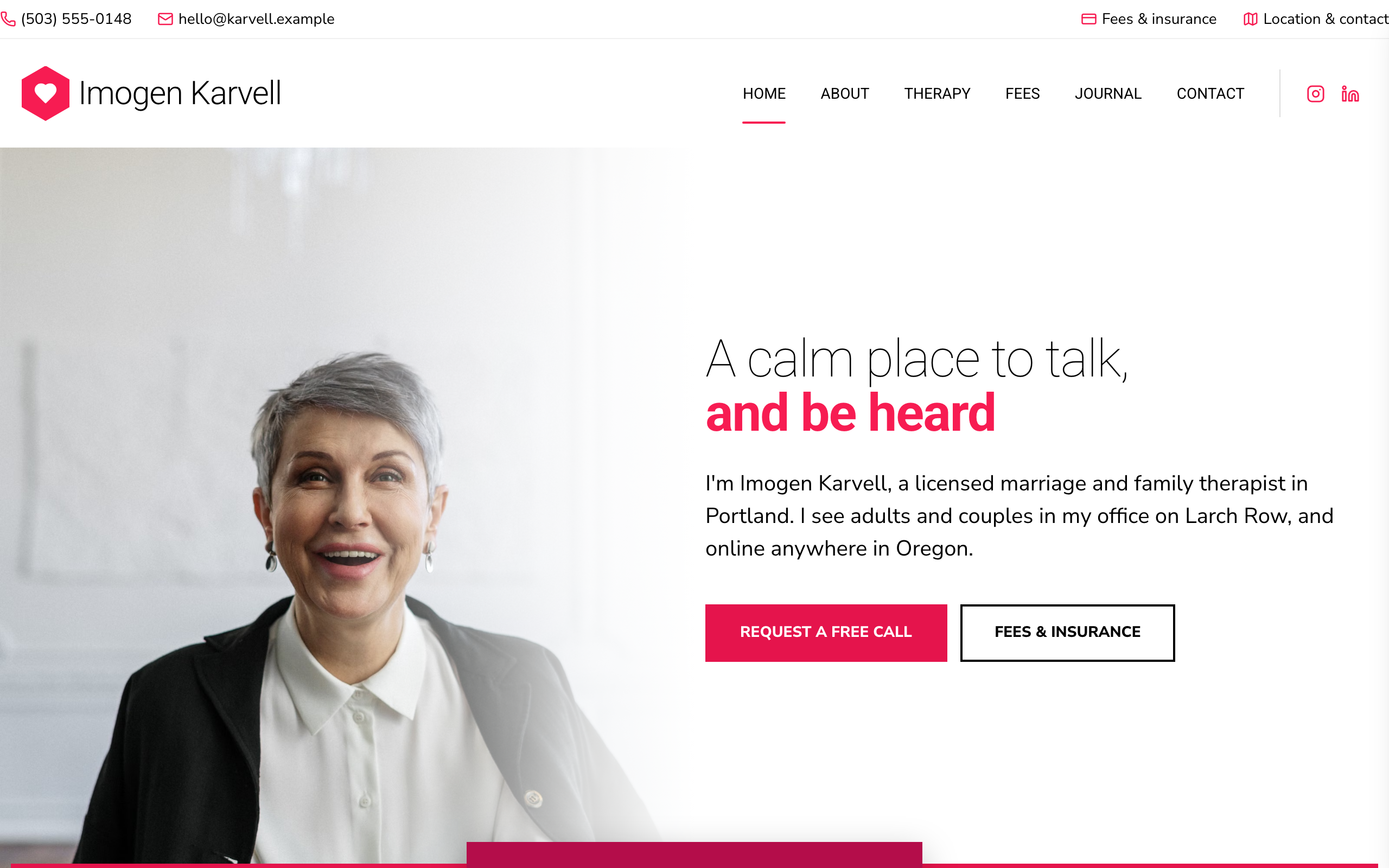
- Where you see people: your town, and whether you also meet online.
- The first step: one button, such as "Request a free call", that says what happens next.

The demo site built for this guide. The first screen says who she is, who she helps, where, and how to start.
Website design for therapists, page by page
1. Home
Lead with the four answers above. Add a short, warm paragraph in your own voice. Then link to your specialties, your fees and the first step. Repeat the first-step button further down, so nobody has to scroll back up.
2. About
People choose a person, not a practice. Share how you work and who you work best with. List your license type and the states you are licensed in, your degree and your training. A real photo of you does more than any stock image.
3. A page for each concern
Give each concern its own page: anxiety, grief, couples counseling, trauma. Say what it can feel like, how you work with it and what a first session involves. These pages also help search. Someone types "grief counselor Portland", not "therapy services".
4. Fees and insurance
Say what a session costs. Say which insurance you take, or that you are out of network. If you are, say how clients can ask their insurer about reimbursement. If you keep sliding-scale spots, say so.
In the US, the No Surprises Act requires a Good Faith Estimate of costs for clients who don't use insurance. Mention it on this page, and send one before the first session.
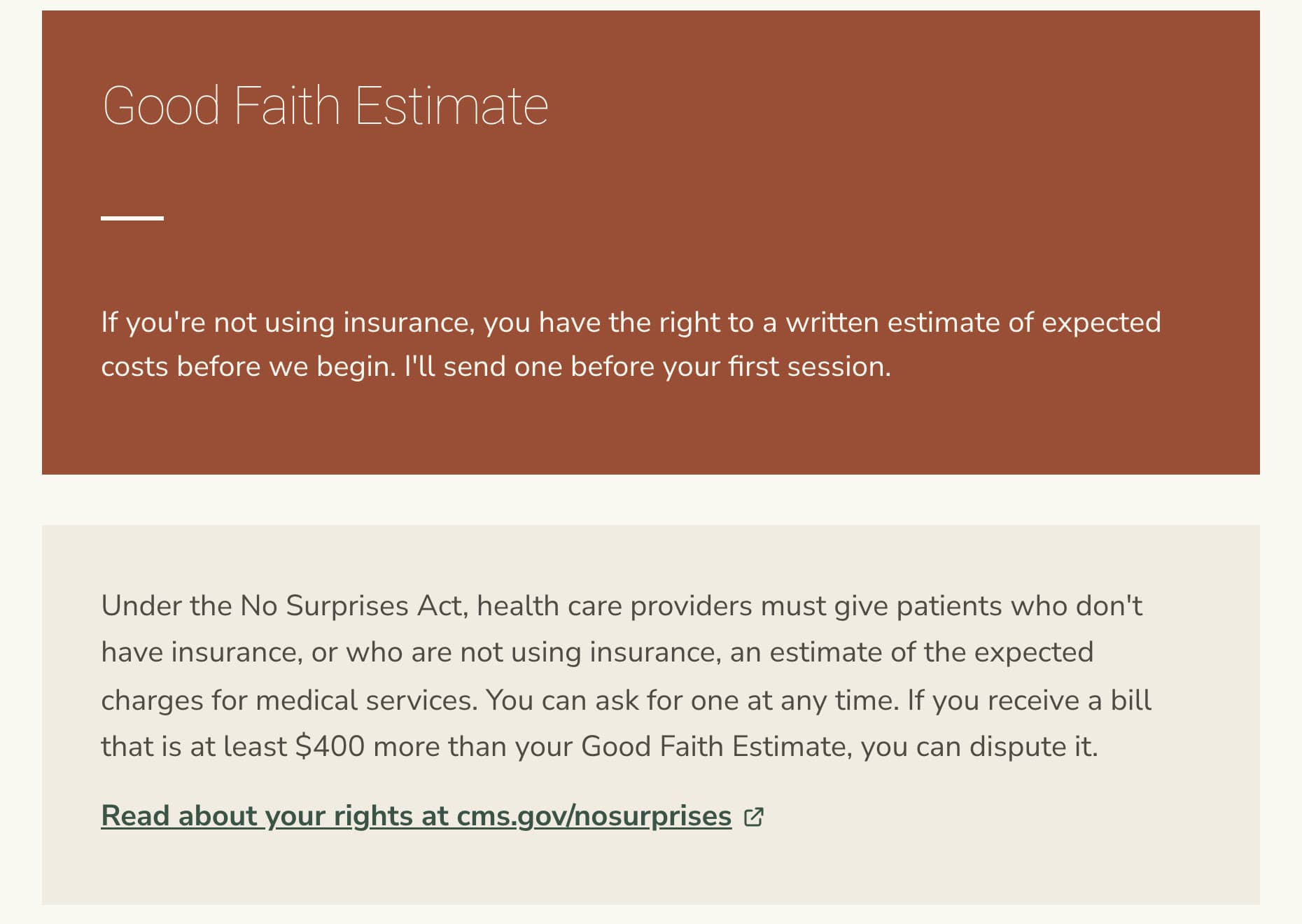
The template's Fees page already carries the Good Faith Estimate notice. Check its wording against your own state's rules.
5. Contact
Keep the form short: a name, a way to reply, what they would like, and office or online. Ask people not to include details about their health. A website form is not the place for them. Add a crisis line, such as 988 in the US, and say the form isn't watched around the clock.
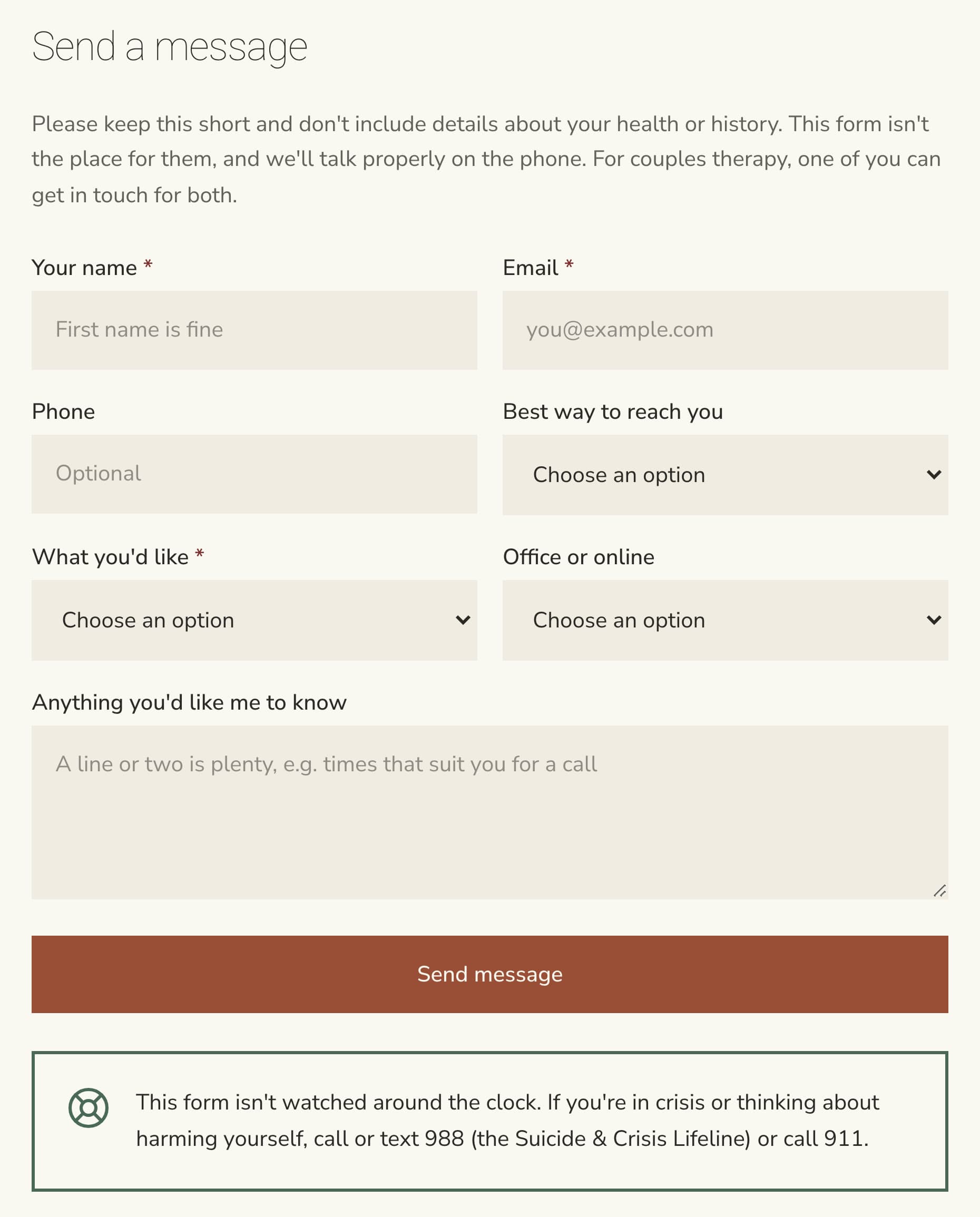
A short contact form that asks for no health details, with the crisis line right beside it.
What to leave off
- Client testimonials. Many professional ethics codes and state boards limit them. Check yours before posting any.
- Health questions in a form. Keep intake and clinical details in your practice-management system.
- Vague wellness words. "Journey" and "holistic" tell a visitor nothing about whether you can help.
Getting found in local search
Most people search for a kind of help and a place. Put both in your page titles and headings: "Anxiety therapy in Portland, Oregon". If you see people online, name the states you are licensed in. Online clients usually need to be located in one of them. Our guide to SEO for chiropractors covers the same local search basics for a practice.
How I built one by asking Claude
I added Sitelas to Claude and sent one message. I described a made-up therapist, Maya Ellison: her license, her city and what she helps with. I added her fee and her insurance status. I asked for a calm site with an easy way to request a free call.
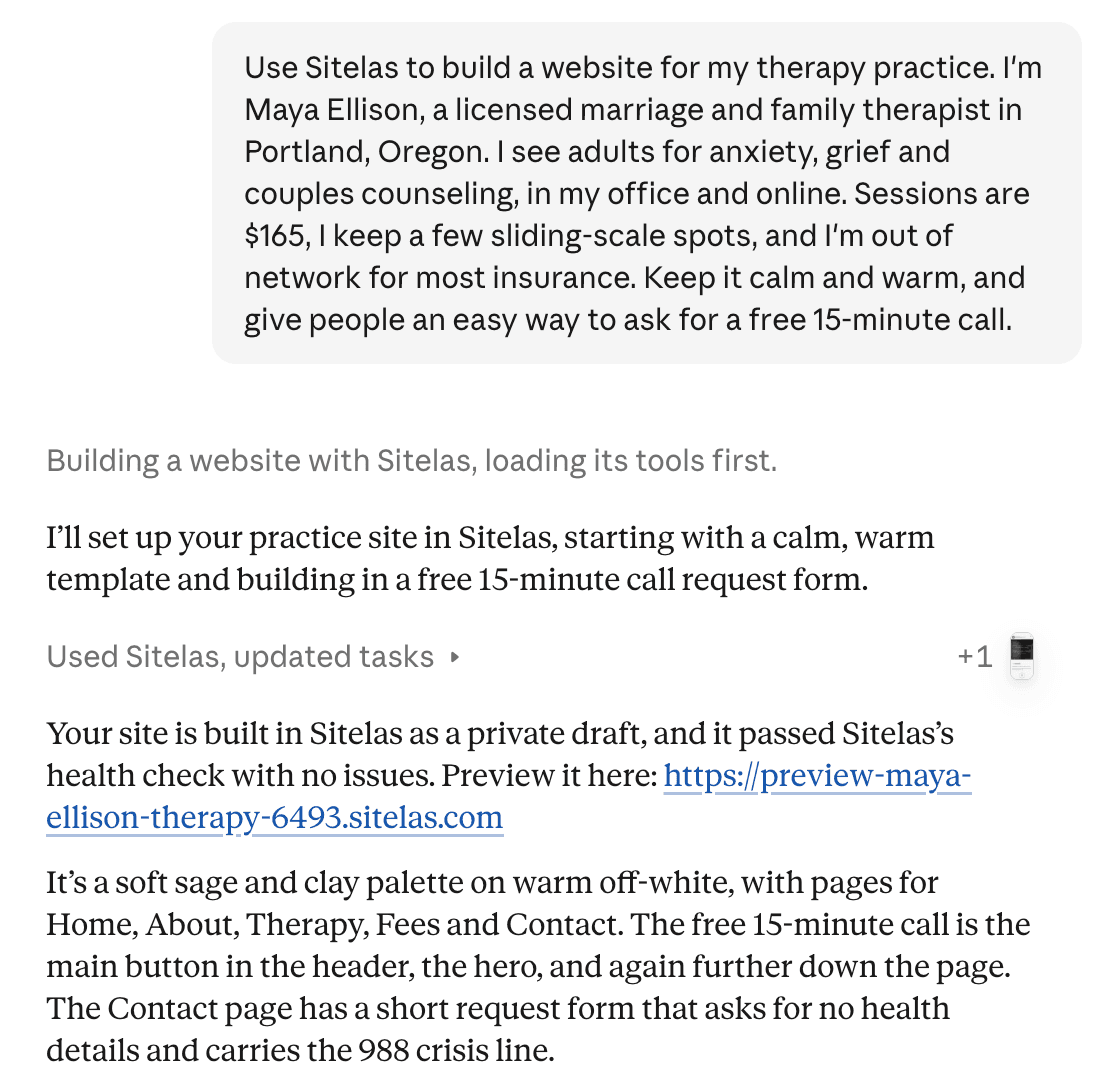
The first message, and the start of Claude's reply. The site is a private draft with a preview link.
Claude started from the Mooring therapist template. It wrote the pages from what I told it. It removed the template's journal, because Maya had no posts yet. Then it listed what it had guessed and what it still needed from me.
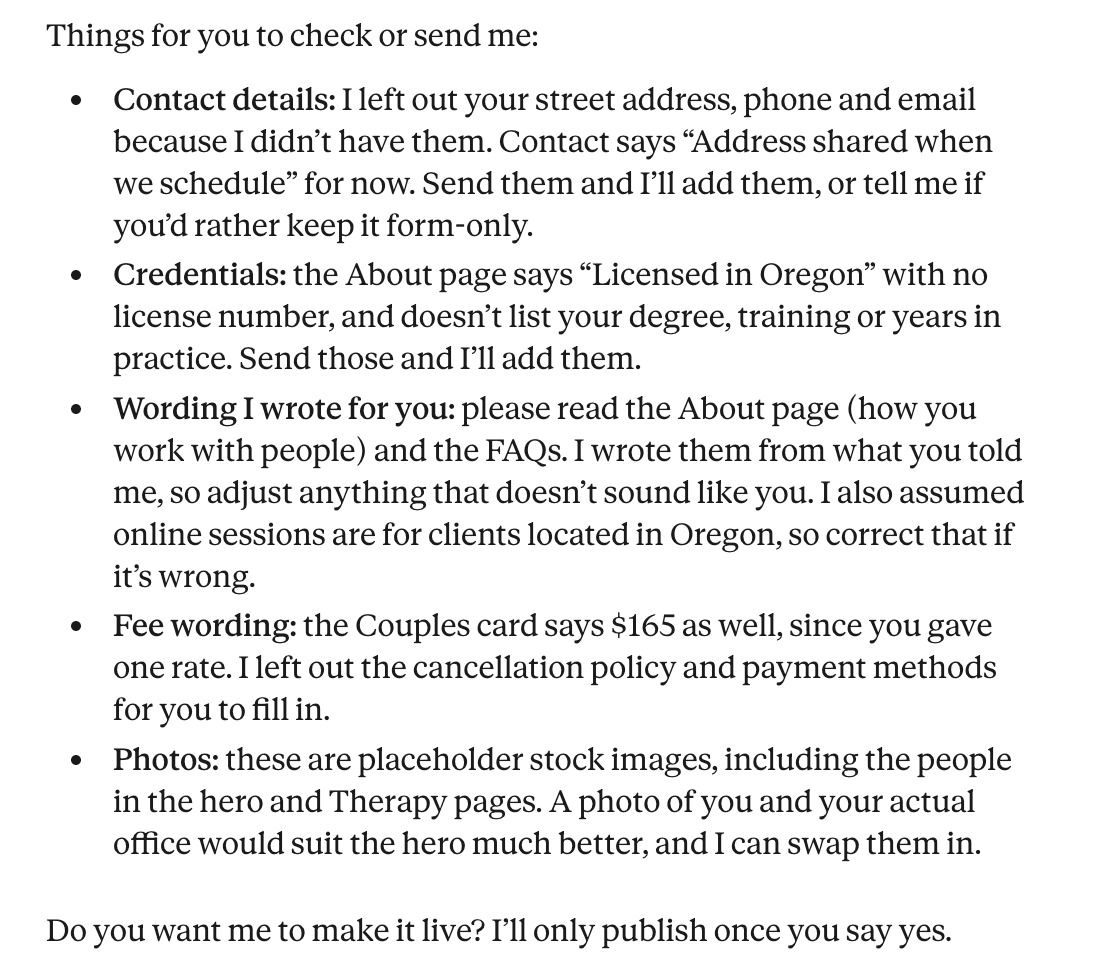
Claude left out what it didn't know, and asks before anything goes live.
That list is worth reading closely. It didn't invent an address, a license number or a degree. The stock photos need replacing with a photo of you and your office. Nothing goes live until you say "publish it".
Changing it later takes a sentence
A practice changes. You add a license, raise a fee or open a new group. On Sitelas, you tell Claude.
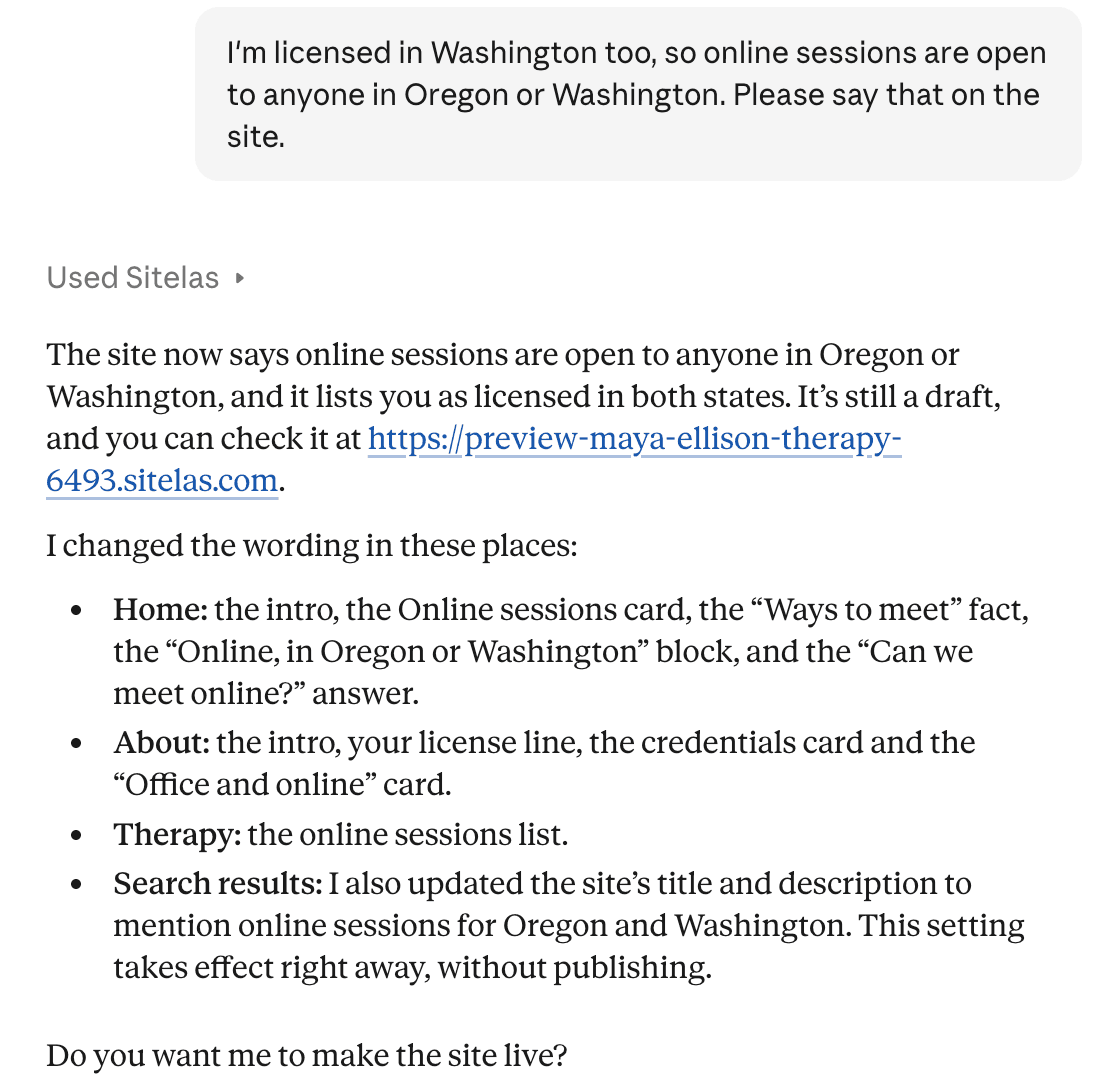
One sentence. Claude found every place that mentioned where Maya sees clients, and updated each one.
The change shows in the preview first. Your live site stays as it was until you publish again. If you would rather click and type, you can also edit the text yourself in the editor.
What it can't do
Sitelas builds and runs the website. It has no booking calendar, no client portal, no secure messaging and no insurance billing. Its contact form is for first enquiries, not health information. A home care agency's site follows the same rule for its free home visit form. If clients book online, point the button at your practice-management system's booking page, or embed a Calendly page.
Questions people ask
How do I make a therapist website? List what you help with, who you are, your fees and how to reach you. Then pick a builder. With Sitelas, you describe your practice to Claude or ChatGPT, check the preview, and publish when it reads right.
What is the best website design for a therapist? Calm, plain and easy to act on. Soft colors and a real photo help. Above all, each page should answer one question a nervous visitor has, with a clear next step.
How much does a therapist website cost? Custom designers charge a one-off fee, and therapist website services charge a monthly one. On Sitelas, one published site is free, on a sitelas.com address with a small Sitelas badge. Pro is $9 a month, or $90 a year, per site. It adds your own domain and lets you read 500 form messages a month instead of 5.
Can clients book a session on my website? Not on Sitelas itself. People can send a request for a call, which lands in your Sitelas inbox. To let them pick a time, link to your scheduling software or embed a Calendly page.
Is a website contact form safe for client information? Treat it like ordinary email. Ask only for a name, a way to reply and a short reason. Keep health details for a secure channel, such as your practice-management system.
New to building by chat? Build a website from a Claude chat walks through the basics. Run your website from a Claude chat covers the updates after launch. Running a clinic rather than a solo practice? See chiropractic website design.
Try it
Copy this into a new Claude or ChatGPT chat after adding Sitelas. Swap in your own details first.
Use Sitelas to build a website for my therapy practice. I'm [name], a [license]
in [city, state]. I see [who] for [concerns], [in my office / online / both].
Sessions are [fee], and I [take these insurers / am out of network].
Keep it calm and warm, with an easy way to request a free [length] call.
- Add to Claude: Sitelas in Claude's connector directory
- Add to ChatGPT: Sitelas in ChatGPT
- See the design we used: the Mooring therapist template
- Other practice designs: medical and wellness templates
Templates to start from
Build this with a ready-made design, then change anything.

Usman Haider
Founder of Sitelas — the website builder for AI agents.