

Add Sitelas to Claude in One Click — Then Say This First
Sitelas is now in Claude's connector directory, so installing it takes one click. The hard part is knowing what to say next — here is the exact first sentence, and the real site Claude built when I said it.

Usman Haider

Adding a connector is the easy part. You click a button, a permission screen appears, you click again, and you land back in a chat box that looks exactly like it did thirty seconds ago.
That's where most people stop. Nothing on screen says anything changed, so the natural move is to close the tab and mean to come back to it.
This post is the other half. Everything below is a real screenshot of a real session — the listing, the permission prompt, the build, and the site that came out of it.
Step 1: Add it from the directory
Open the Sitelas listing in Claude's directory and click add.
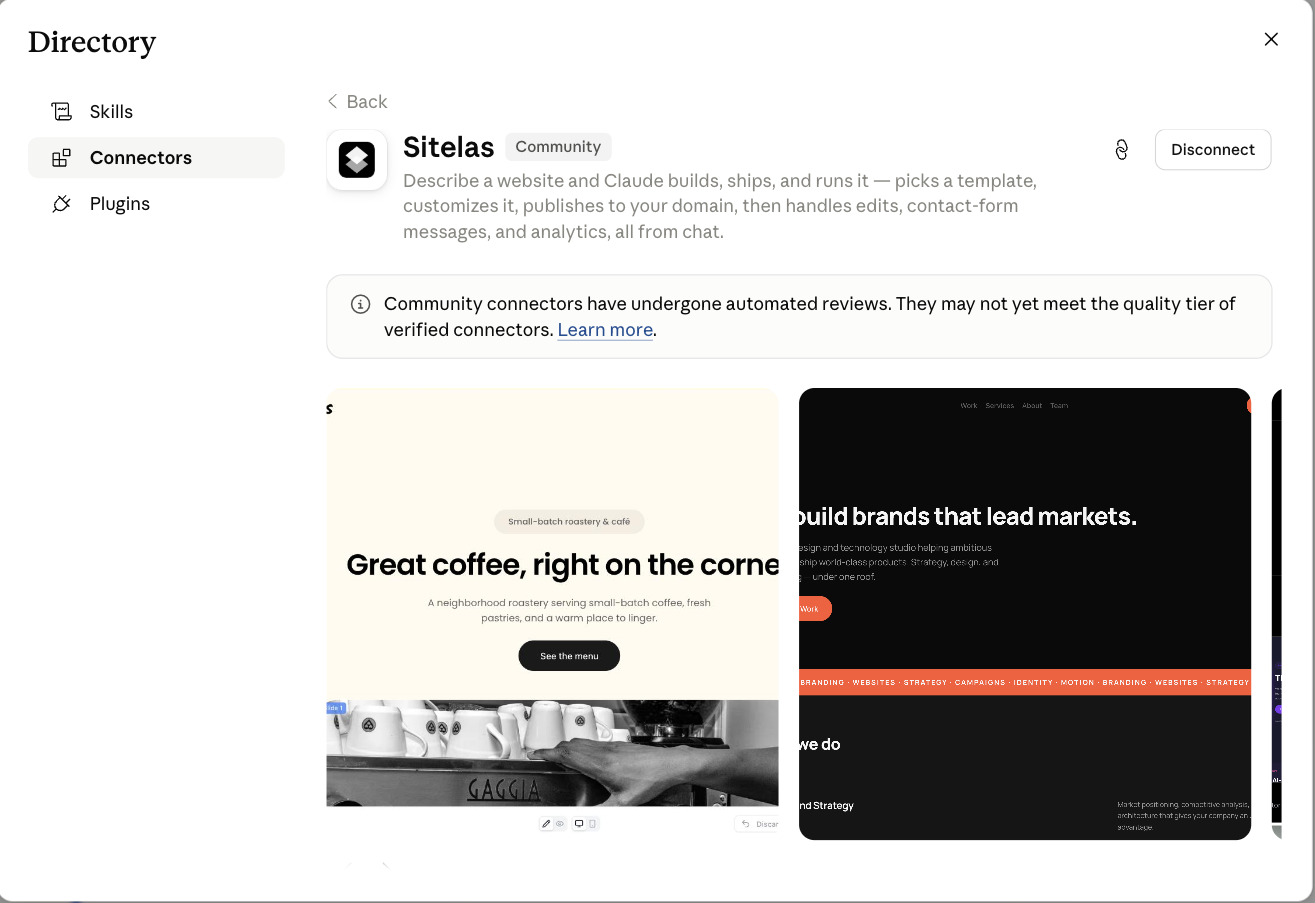
That's the whole setup. No URL to paste, no config file to edit. Claude sends you to Sitelas to sign in — or create your account, if you don't have one — and approve the connection, then drops you back where you started.
Two things worth reading on that screen. Sitelas sits in the Community tier, and Claude tells you plainly what that means: community connectors have undergone automated reviews, and may not yet meet the quality tier of verified connectors. And the description is the honest scope of the thing — Claude picks a template, customizes it, publishes to your domain, then handles edits, contact-form messages and analytics, all from chat.
Using Claude Code or Claude Desktop instead? Those read connectors from a config file and never see the directory, so they still take the raw MCP endpoint:
https://sitelas.com/api/mcp.
Step 2: Read the screen before you click Connect
One screen stands between the click and the connection, and it's the only place that spells out what you're handing over.
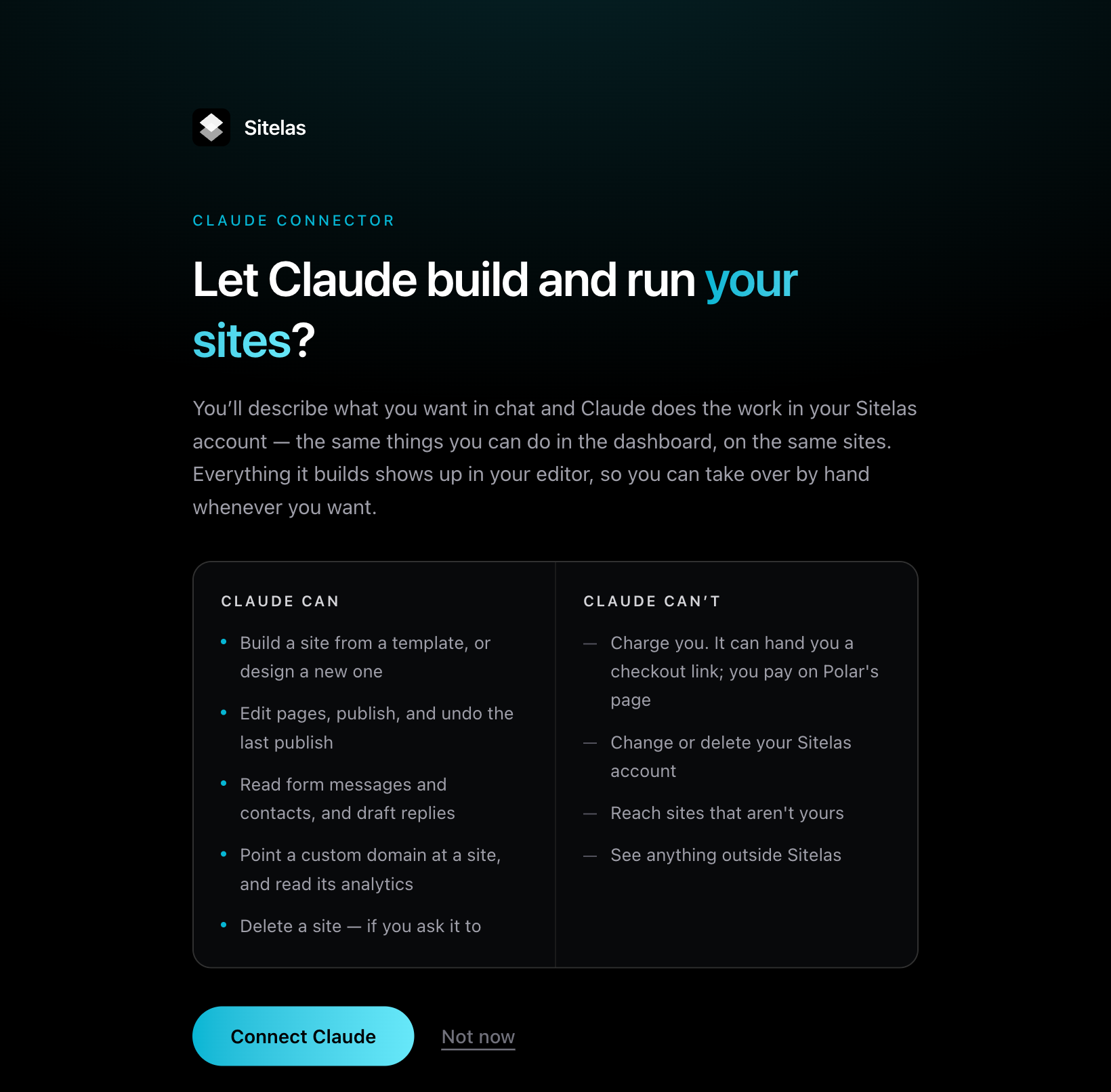
The left column is what Claude can do in your account: build a site from a template or design a new one, edit pages, publish, undo the last publish, read your form messages and contacts, draft replies, point a custom domain at a site, read its analytics — and delete a site, if you ask it to.
That last one is in the "can" column on purpose. Naming the uncomfortable capability is what makes the right-hand column worth believing:
- It can't charge you. It can hand you a checkout link; the payment happens on Polar's page, not through Claude.
- It can't change or delete your Sitelas account. No such tool exists.
- It can't reach sites that aren't yours. Every tool is scoped to the account that approved the connection.
- It can't see anything outside Sitelas.
Everything Claude builds also shows up in your normal editor. Connecting doesn't move your sites somewhere Claude-shaped — same sites, same dashboard, second way in.
Step 3: The first thing to say
Describe the thing you want the way you'd describe it to a person — what it's for, roughly how it should feel, what the visitor should do. Here's the exact sentence I used:
Build a one-page site for Fettle & Spoke, a neighbourhood bike workshop — repairs, servicing and wheel building. Warm and hand-made feeling, not corporate. Add a contact form so people can ask about a repair.
The first time Claude reaches for a Sitelas tool, it asks:
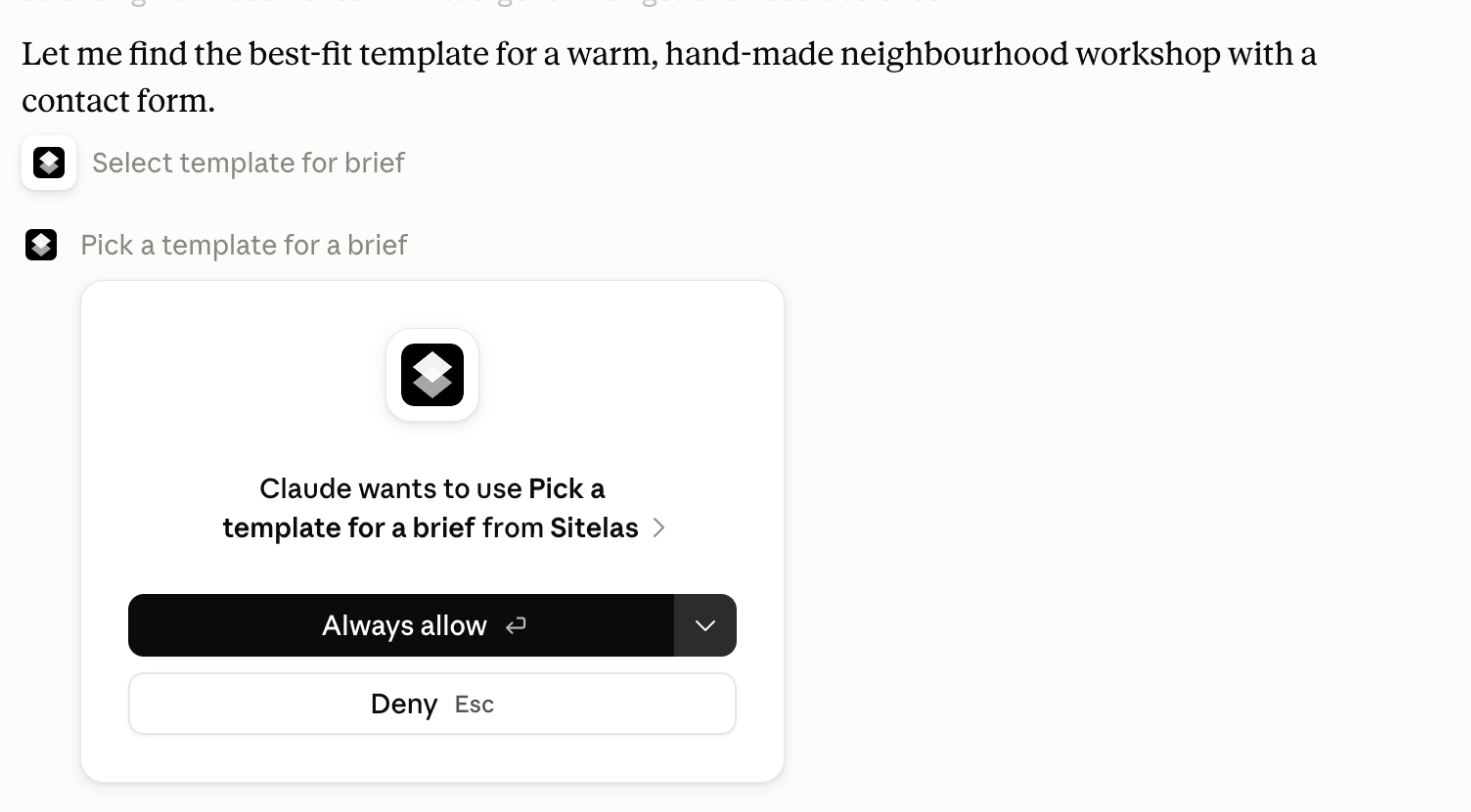
You approve per tool, or once for all of them. Either way the first move is yours.
Then it works. Not by filling in a template — it looked at the closest archetype and rejected it out loud: "Gable is the closest archetype but it's built around a multi-page before/after project portfolio — overkill for a warm one-pager." So it composed the page from primitives instead, picked the type, and went looking for workshop photography.
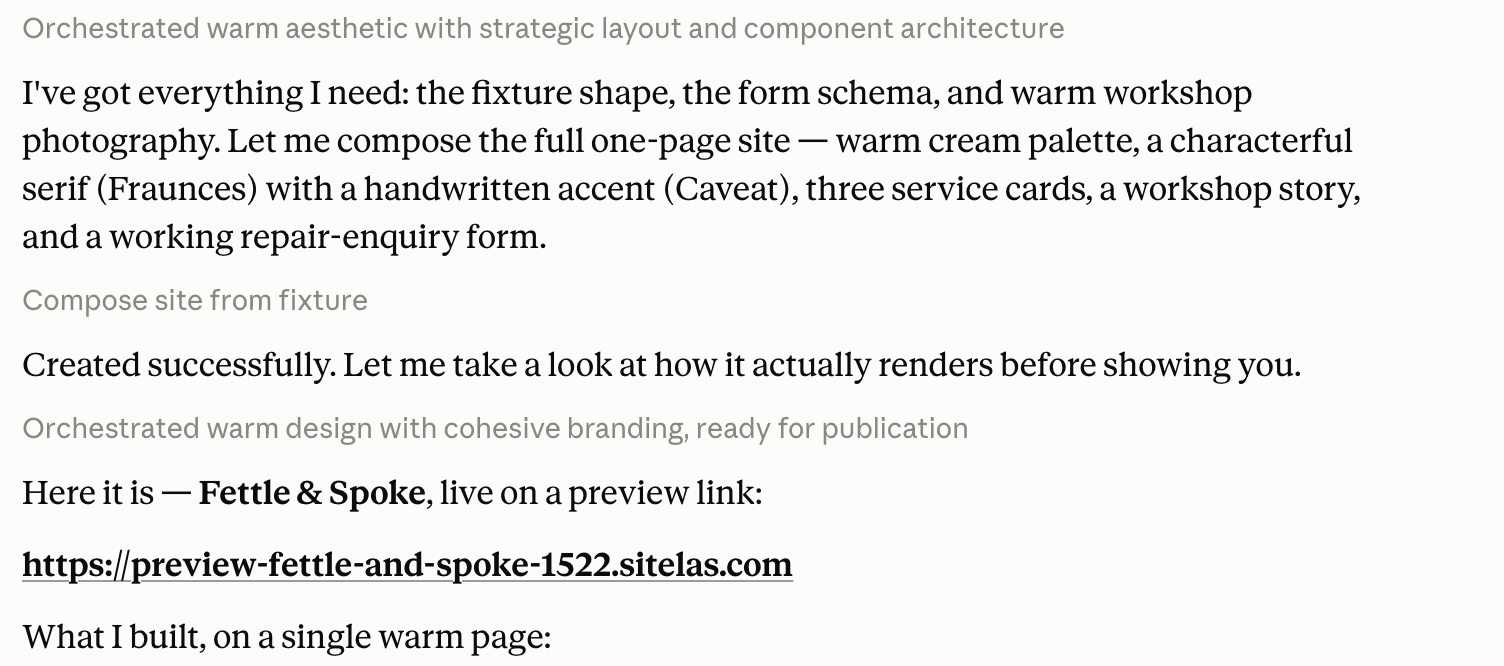
Note the step in the middle — "Created successfully. Let me take a look at how it actually renders before showing you." It screenshotted its own work before handing it over.
The bit that matters: nothing is public yet
What came back is a preview, not a live site. That isn't a figure of speech. At the moment Claude finished, here is what the two addresses actually returned:
| URL | Status |
|---|---|
preview-fettle-and-spoke-1522.sitelas.com |
200 — the finished site |
fettle-and-spoke-1522.sitelas.com |
404 — doesn't exist yet |
So you get to see the whole thing, click every link, and change your mind, with no chance of anyone stumbling onto a work in progress. Here's what was sitting at that preview address:
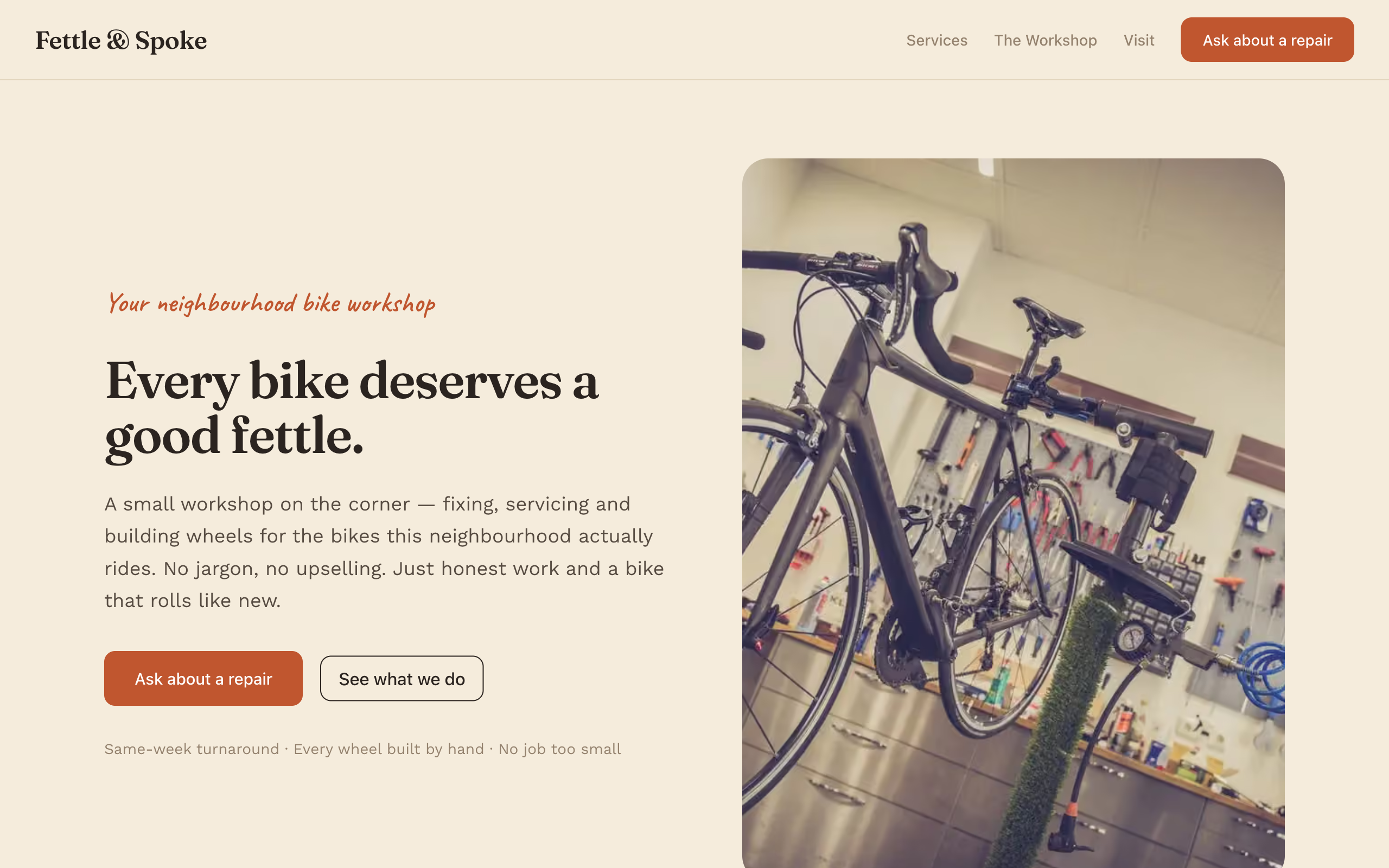
The second thing to say is whatever you want changed:
- "Warmer palette, and cut the hero copy to two sentences."
- "Move the enquiry form above the workshop story."
- "Swap the photo for something with more negative space."
Each one updates the draft and hands back the same preview link, refreshed. When it's right, say "publish it" — the only step that makes anything public, and it only ever happens because you asked.
Step 4: The prompt people forget — after it's live
Most website tools stop caring once the site ships. This is the half that makes the connector worth keeping.
Every form on your site sends submissions to your Sitelas inbox with no setup at all — the repair-enquiry form on Fettle & Spoke was wired the moment it was built.
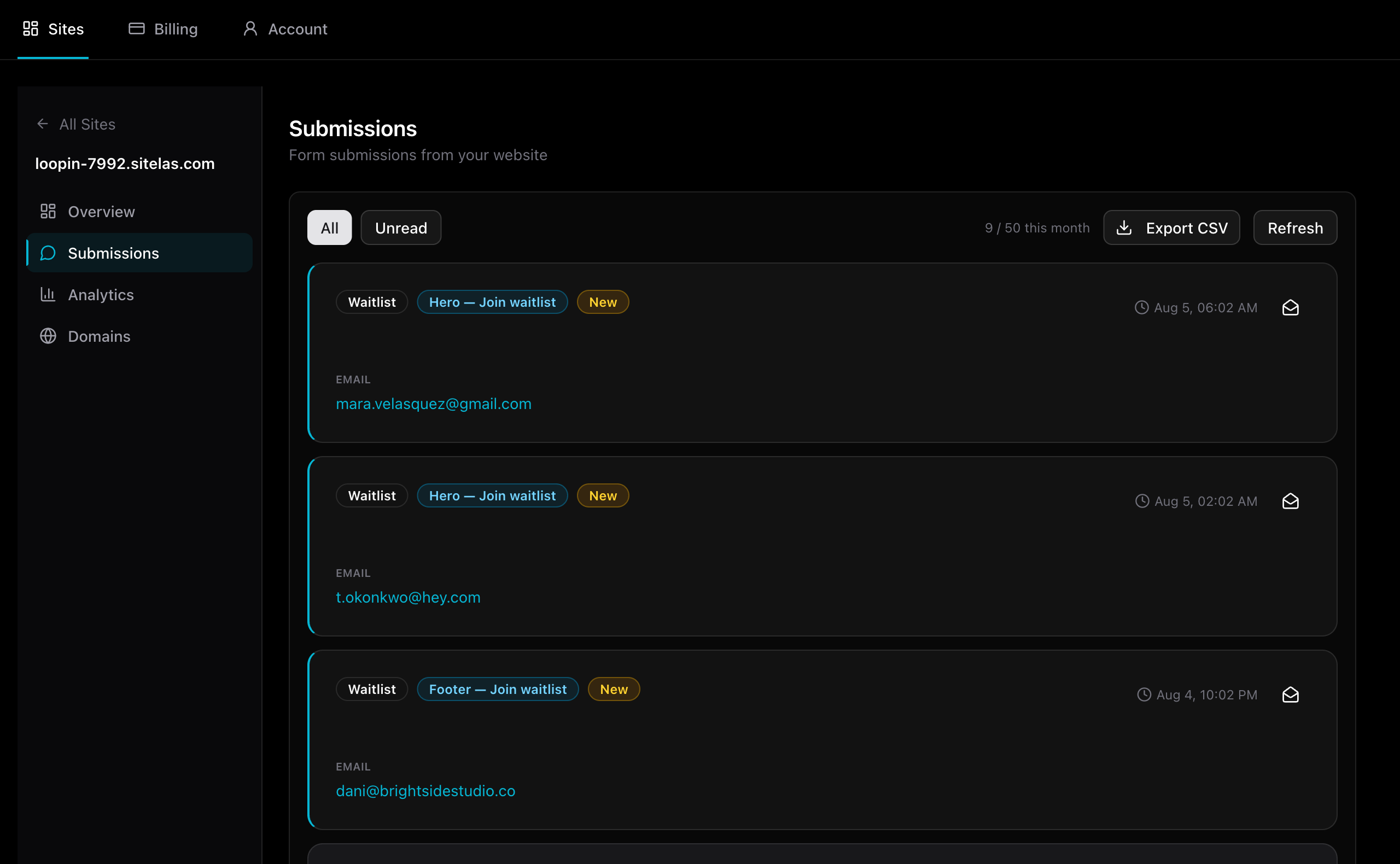
You can read that in the dashboard whenever you like. Or you can just ask, in the same chat that built the site: "Any new messages this week, and where did they come from?" Claude already has the context — it built the page, it knows which form is in the hero and which is in the footer, and it reads the results without you exporting anything. If you want submissions somewhere else too, each form takes a webhook URL in the editor, which covers Zapier, Make, n8n, or your own endpoint.
The three sentences, together
If you only remember one thing from this post, make it these:
- "Build me a [what it is] — [how it should feel]." → a designed draft and a private preview.
- "Change [the thing you don't like]." → same preview, updated. Repeat freely.
- "Any new messages on my site this week?" → your form submissions, read back to you.
Everything above happened in one sitting, in one chat, with no dashboard open. That's the whole loop.
Next: launching a waitlist from Claude Cowork follows the same loop on a page that's already live and collecting signups. If you'd rather hand the work to an autonomous agent than type in a chat, an AI agent can build and run a site with an account API key instead. And running your website from the same chat that built it goes deeper on the operate half.

Usman Haider
Founder of Sitelas — the website builder for AI agents.


