

Launch a Waitlist From Claude Cowork — Then Ask It What Came In
One workspace builds the page, publishes it, and reads the submissions back to you in plain English. Here's the whole loop, including what the digest email actually says.

Usman Haider

Launching a waitlist is the easy half. You can get a decent page up in an afternoon.
The half that dies is the running of it. Two weeks later nobody has opened the form tool, nobody knows whether Tuesday brought four signups or none, and the "we'll review them weekly" habit lasted exactly one week. The page is still live. The loop is dead.
So I tried something different for my last one: I launched it from Claude Cowork, and before I closed the workspace I asked Claude to check the signups every morning and email me what came in. That second sentence is the one that interests me — it's what turns a page you published into a loop you can actually stay on top of.
The product is Loopin, a fictional group-chat planning app I use for demos. The page is real and live at loopin-7992.sitelas.com, and the digest email is real too — I've quoted it in full below rather than describing it. Here's the whole loop, end to end.
Cowork vs. a chat (the 30-second version)
If you've only used claude.ai as a chat, Cowork is the same Claude with a workspace around it: a task view, progress tracking, and — the part that matters here — scheduled tasks. You can hand Claude a job and a time, and it runs on its own.
That's the difference between the waitlist I ran from a single chat and this one. In a chat, you're present for every step; the work happens because you're there. In Cowork, you set the job up once and it keeps happening while you're doing something else.
Both need Claude to actually be able to touch your site. That's what the connector is for.
Connect Sitelas once
One-time setup: Sitelas is in Claude's connector directory, so adding it takes one click — open the listing and choose Add.
Using Claude Code or Claude Desktop instead? Those read a config file rather than the directory, so point them at https://sitelas.com/api/mcp.
Sign in, approve, done. Claude can now design sites, publish them, read form submissions, and pull analytics — for any Sitelas site you own. The connector is available in Cowork the same way it's available in a chat; you'll see Sitelas listed under the workspace's connectors.
Step 1 — Launch the page
I opened a Cowork task and described the product rather than the design:
Build a waitlist page for Loopin — it lives inside your existing group chat and turns "we should get dinner sometime" into an actual calendar invite. Works with iMessage, WhatsApp, Discord, Telegram, Slack. Warm and a bit funny, not enterprise SaaS. Email capture, and a short "how it works" section.
Claude picked an archetype, wrote the copy, and came back with a preview URL — not a live site. This is worth understanding because it's how every Sitelas change behaves: work lands on a draft, you get a preview link, and the public URL doesn't change until you say publish. You can iterate as many times as you like; visitors keep seeing the last published version, or nothing at all if you've never published.
I asked for two changes — a warmer headline, and the channel logos moved above the fold. Each came back as an updated preview. When it read right, I said make it live, and Claude published it.
The headline it landed on:
Someone says "soon." Loopin makes it Thursday.
That's better than what I'd have written, and I say that as the person who would have written it.
One honest note about the page: the social-proof numbers on it ("9,300+ group chats") are demo copy from the design, not real signups. The real count is one, and it's mine — which becomes relevant in a moment, and is a more useful thing to show you than a fake number.
Where the signups actually go
Every submission from that form lands in the Sitelas inbox — your dashboard, under Messages. No setup, no third-party form tool, no spreadsheet to wire up. That's the default and it's the only destination you need.
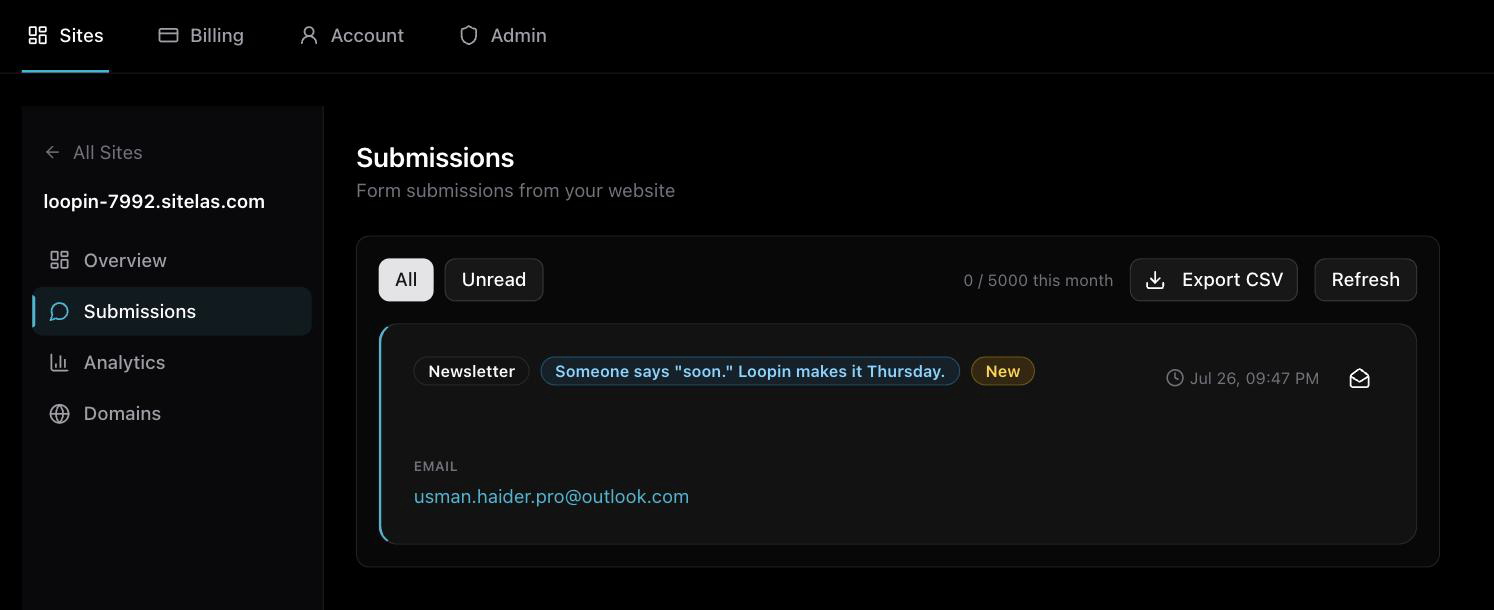
That is the real Loopin inbox, and it contains exactly one entry — mine. I submitted the form myself on launch day to check it worked. Each entry expands to show exactly the fields the form asked for; a form with more fields shows more. The fact that it is otherwise empty matters in a minute.
If you do want submissions somewhere else, each form has a "Forward to webhook" setting in the editor: point it at an HTTPS endpoint — Zapier, Make, n8n, your own handler — and each submission is POSTed there as well. That's the route to a Google Sheet or a CRM, via a Zap that appends a row. There's no OAuth dance and no accounts to link; it's one URL field.
The reason this matters for the automation: because submissions live in Sitelas, Claude can read them through the connector. No export, no CSV, no "log in and check."
Step 2 — The part that makes it run
Here's the actual move. Still in Cowork, I created a scheduled task:
Every morning at 9:30, check the Loopin waitlist for submissions from the last 24 hours. Email me a short digest: how many signed up, who they are, and anything that stands out. If there were no new signups, say so in one line — don't skip the email.
Then I approved it once, and closed the tab.
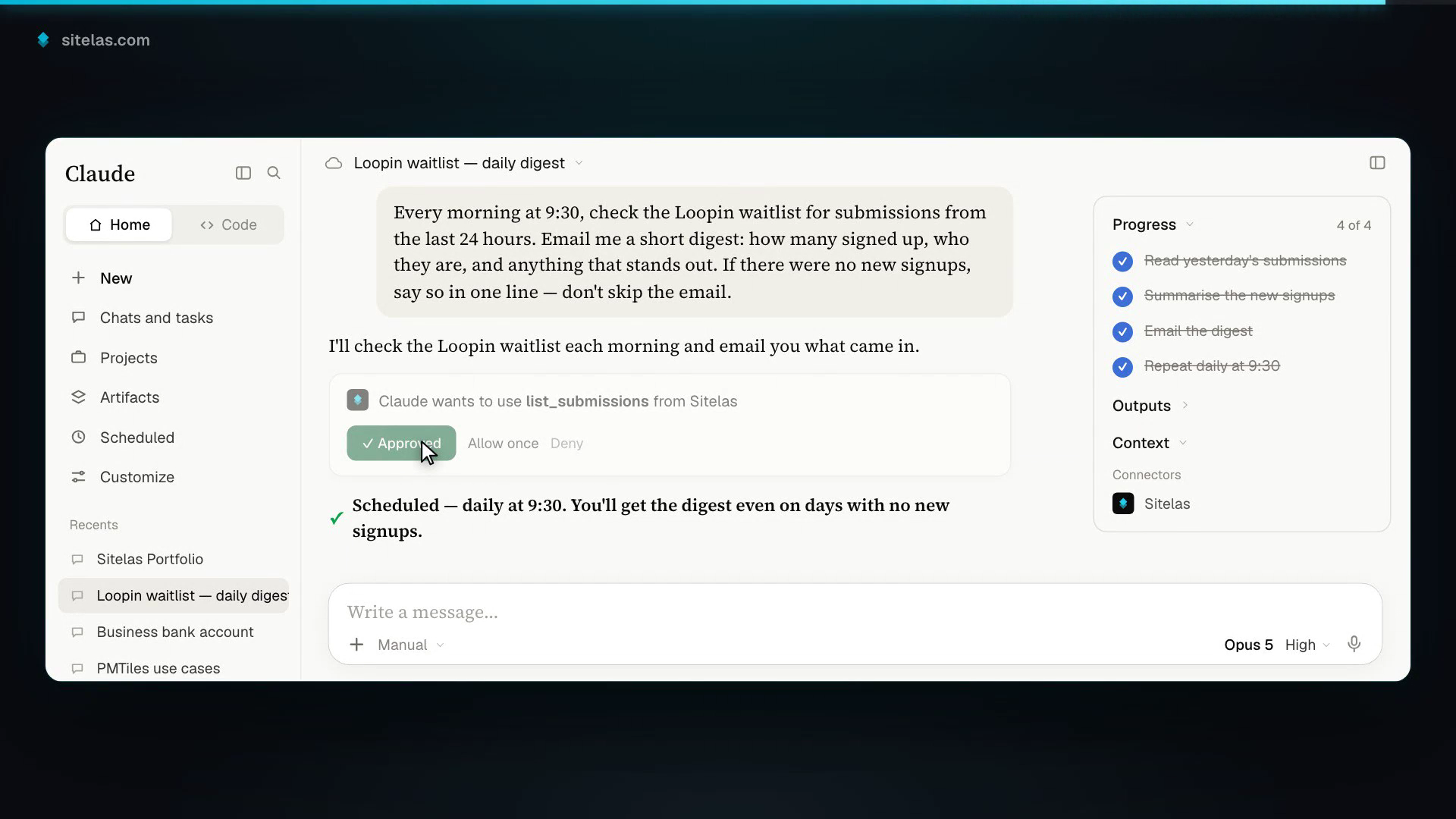
Three things about that prompt are deliberate, and each one is a thing I got wrong before getting it right:
"Email me." Cowork scheduled tasks run on their own and show their results in the app. If you want something in your inbox, the task has to say so. The mail then arrives from Claude's own address — mine came from no-reply-claude@mail.anthropic.com — not from Sitelas, and not from your own account. Leave that sentence out and the task still runs perfectly; you just have to go and look at it, which is the exact habit that dies.
"Last 24 hours." Without a window, you get a digest of the entire list every morning, which stops being information by day three.
"If there were no new signups, say so — don't skip the email." This is the one I'd argue for hardest. A system that only speaks up on good news is indistinguishable from one that's quietly broken, and you find out which you have three weeks in, when you discover the form stopped submitting on day two. The empty email costs nothing and it's the only proof the loop is still alive.
What the digest actually looks like
I was impatient, so the next morning I test-fired the task by hand instead of waiting for 9:30. The email arrived a couple of minutes later, from Claude's own address:
Loopin: 1 new waitlist signup in the last 24h — usman.haider.pro@outlook.com, Sun 26 Jul 9:47 PM PKT. That's the first signup ever, so all-time total is now 1 and there's no meaningful trend yet. Quota is fine: 1 of 50 used this month, resets 1 Aug. Note the form only asks for an email, so no name was captured. Submission left unread for your triage.
That one signup is me — I'd filled in my own form the previous evening to check that submissions actually landed, and it fell inside the 24-hour window. As proof that the world wants Loopin, it's worthless. As a picture of what the loop does, it's exactly right.
Read what's in that paragraph. I asked for "how many signed up, who they are, and anything that stands out." What came back was the count, the address, the timestamp, the all-time total for context, the month's quota, the reason no name was captured, and a note that it had left the submission unread so I could triage it myself.
None of that is a database dump. Claude opened the actual submission through the connector and wrote up what it found — which is only possible because the submissions live in Sitelas rather than in a form service Claude can't see.
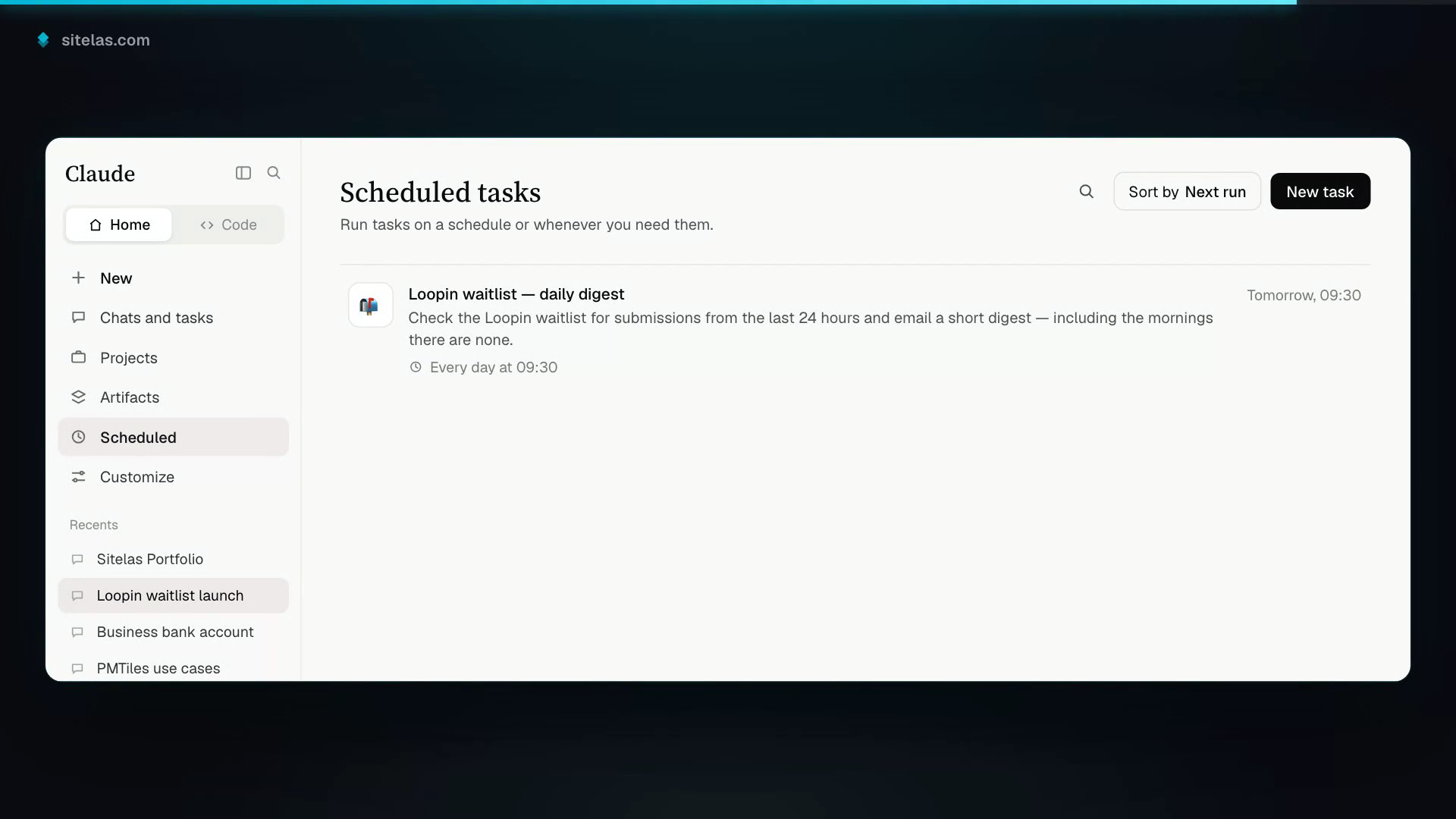
The task itself is one row on Claude's Scheduled page. That is the whole of the automation — no server, no cron file, no dashboard of my own to maintain. If I want it to stop, I delete the row.
The loop, in one picture
That's the entire shape of it, and it's worth stating plainly because it's the bit that's genuinely new:
- You describe the page. Claude builds it and hands you a preview URL. Nothing is public until you say publish.
- A visitor fills in the form. The submission lands in your Sitelas inbox — no form service, no spreadsheet, no wiring.
- You ask Claude what came in. It reads that inbox through the connector and answers in plain English, on demand or on a schedule.
Every one of those steps happens in the same place, with the same assistant, and none of them asks you to export anything.
The honest caveats
A few things Sitelas doesn't do, so you can plan around them rather than discover them:
- No bulk email sender. When you're ready to invite the list, Claude can draft individual emails through your own Gmail connector — genuinely good for a focused early-access batch, and not a substitute for Mailchimp at 50,000 addresses.
- No CRM and no native scheduling. The inbox is a list of submissions, not a pipeline.
- Commerce is single-item. A waitlist doesn't need it, but if you're thinking of a paid pre-order: Sitelas supports one Stripe payment link per item, not a cart.
And one about Cowork: a scheduled task is Claude doing the work on a timer, not a background service inside Sitelas. It's worth knowing which system owns which half — Sitelas holds the site and the submissions; Cowork holds the schedule.
One note on my own demo, so you're not misreading the screenshots: the digest I've quoted is a manual test fire, not the 9:30 run. I set the schedule up, fired it twice by hand to see the output, and then deleted the task — with one submission in the inbox, and that one mine, there was nothing for it to watch yet. The mechanism is the same either way; I just don't want you to think I've been running this for weeks.
Why this is different from a website builder
The page took about fifteen minutes. Any decent builder could have done that part.
What no static-site builder can do is the second half: the site is an automation endpoint sitting next to your other connectors, so the same assistant that built it can read its submissions, summarize them, and put them in your inbox on a schedule — without you exporting anything or opening a dashboard.
That's the actual pitch for running a site from the same place you built it. And it's the same capability an autonomous agent uses when it builds and runs a site with an API key — Cowork is just the friendlier door to it.
Try it
Add Sitelas from Claude's connector directory — one click — then ask Claude to build the waitlist you've been putting off.
Then, before you close the tab, ask it to check the signups every morning and email you what it finds. That second sentence takes ten seconds and it's the difference between a page and a loop.
Sitelas — the website builder for AI agents.

Usman Haider
Founder of Sitelas — the website builder for AI agents.