

Mainstay
A website template for a multi-trade handyman or property maintenance firm
Most local-trade sites are brochures. This one is a phone number with a site attached. The number is a real `tel:` link in the header, in both hero buttons and in the closing band — on a phone that is one tap, which is how this trade actually gets booked.
Who Mainstay is for
Built for these, and tested against them.
- Multi-trade handymen and property maintenance one- or two-person firms
- Plumbers, electricians and carpenters who take small domestic work
- Painters and decorators quoting room by room
- Any local trade that gets booked over the phone rather than by email
- Sole traders who want to stop answering ‘do you cover my area?’
What’s included
Everything below ships with the template, already filled in.
- Pages
- 4 pages, written and laid out
- Grows with you
- 6 project entries at /work/ — add one and its index and detail page both update
- Enquiries
- A working form — messages land in your Sitelas inbox
- Type
- Archivo Black and Work Sans · light theme
- Everywhere
- Built and checked at phone, tablet and desktop widths
- Yours to change
- Every colour, word and photograph — in the editor or by asking an AI agent
About This Template
For the trade that lives on the phone
Sells availability and price, not craft
Ironcald and the other trade template lead with a body of work. A handyman is hired on different grounds: can you come this week, will you turn up, and will the bill match the quote. So the page leads with a trust strip (DBS checked, £2m insured, fixed quotes, same-week), names the neighbourhoods it covers, and publishes the price actually charged on every recent job.
Honest about scope
The services page says plainly what the business will not take on — gas, structural, roofs above single storey. Saying no to the wrong jobs is what makes the yes credible, and it saves the owner a week of unqualified calls.
When to pick something else
Mainstay is the wrong template for these. Where there is a better one, it is linked.
Free to use · No credit card required
- 1Opens in the editor with the starter content in place
- 2Change the words and pictures to yours
- 3Publish to a sitelas.com address, or your own domain
Key Highlights
Questions about Mainstay
Can I change how Mainstay looks?
All of it. Colours, type, spacing, photographs and every word are yours to edit — in the visual editor, or by asking an AI agent to do it for you. Nothing is locked.
Do I need to know how to code to use Mainstay?
No. You edit the page by clicking the thing you want to change. There is no code to write and nothing to install.
Can I add more project entries later?
Yes — that is what the project collection is for. Adding one from the editor creates its own page at /work/ and updates the index automatically. You are not editing a list by hand.
What does Mainstay cost?
Nothing to start, and there is no trial clock. A free site runs on a sitelas.com address; Pro is $9 a month per site when you want your own domain, analytics and more room.
Can I use my own domain?
Yes, on Pro. Point your domain at the site and SSL is issued automatically — there is no certificate to buy or renew.
Make Mainstay yours
It opens in the editor with every page already written. Change what you want, publish when it reads like you.
Free to use · No credit card required
Related Templates

Hatch
Company careers page for funded tech / AI startups (Series A–C, 20–80 person teams). Deep slate navy + warm cream + coral accent, Fraunces serif on Inter — modern-tech-company register that reads as confident-but-human. Three pages plus role-detail (collection-driven): Home / Open roles / Life at Hatch / per-role detail with apply form. Conversion is candidate application (formType `application`, submissions land in your inbox, with optional webhook forwarding). Distinct from `whitford` (law firm authority-formal) and `flagship` (agency / B2B sell) — this is a hiring page, not a sales page or a recruiting agency.
Ironclad
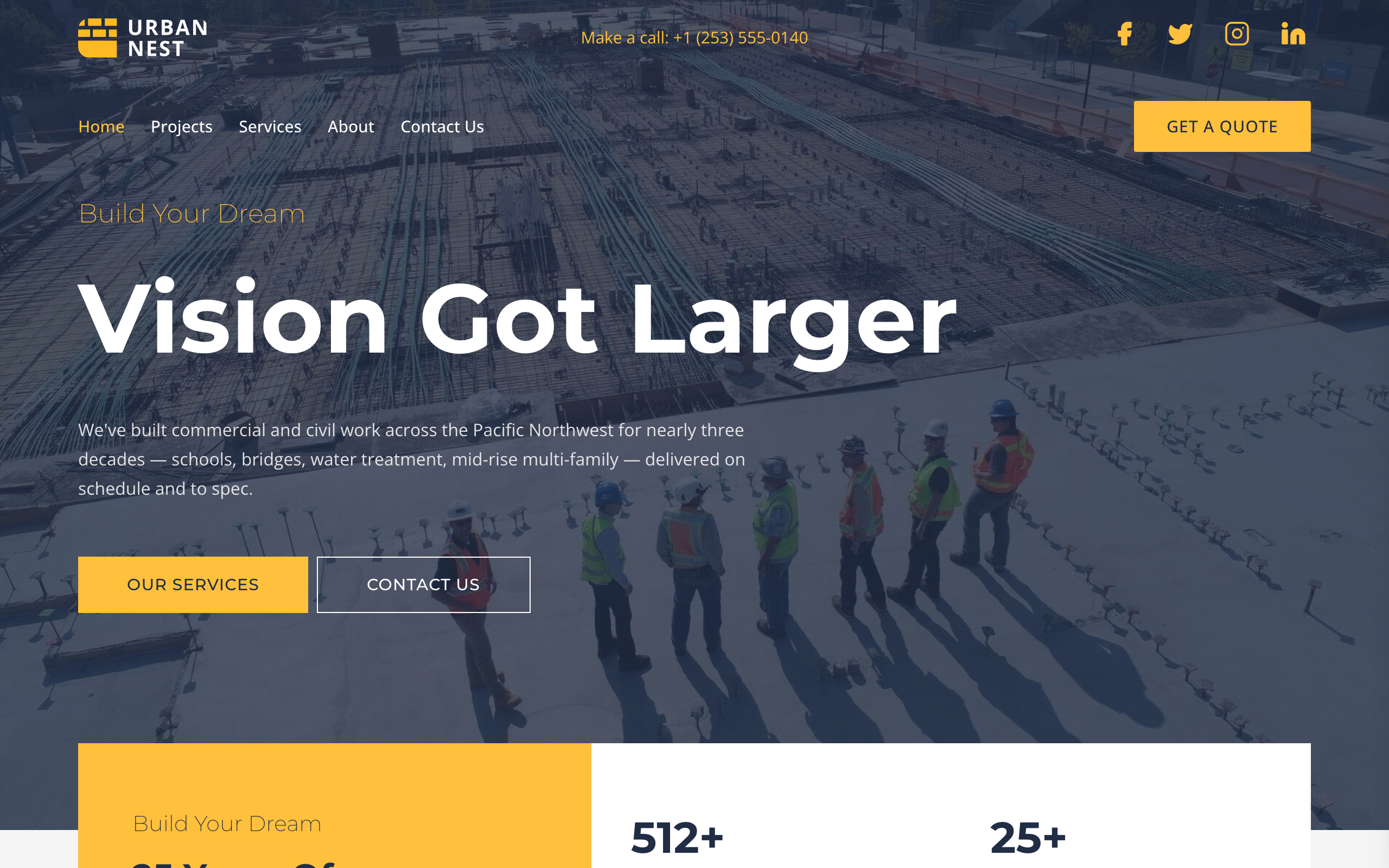
Utilitarian-trustworthy construction GC template — Urban Nest persona. Deep slate navy + industrial yellow + sharp 0/2-radius buttons. Transparent absolute header (logo / phone / socials over hero divider, then nav + Get a Quote pill). Full-bleed dark hero with 90px Montserrat 700 headline, yellow stats card overlapping the hero/services boundary, six-tile services grid on a 1200px container, two-tone sustainability split with image overlays, three-location row + Transform Communities CTA, asymmetric founders strip with bottom-fade meta + ABOUT US CTA, four-project full-bleed work strip, dark 2x2 testimonial grid with yellow bottom borders, quote form + FAQ split. Multi-page (Home / Projects / Services / About / Contact). Montserrat 200/500/700 on Open Sans.
Kilnwork
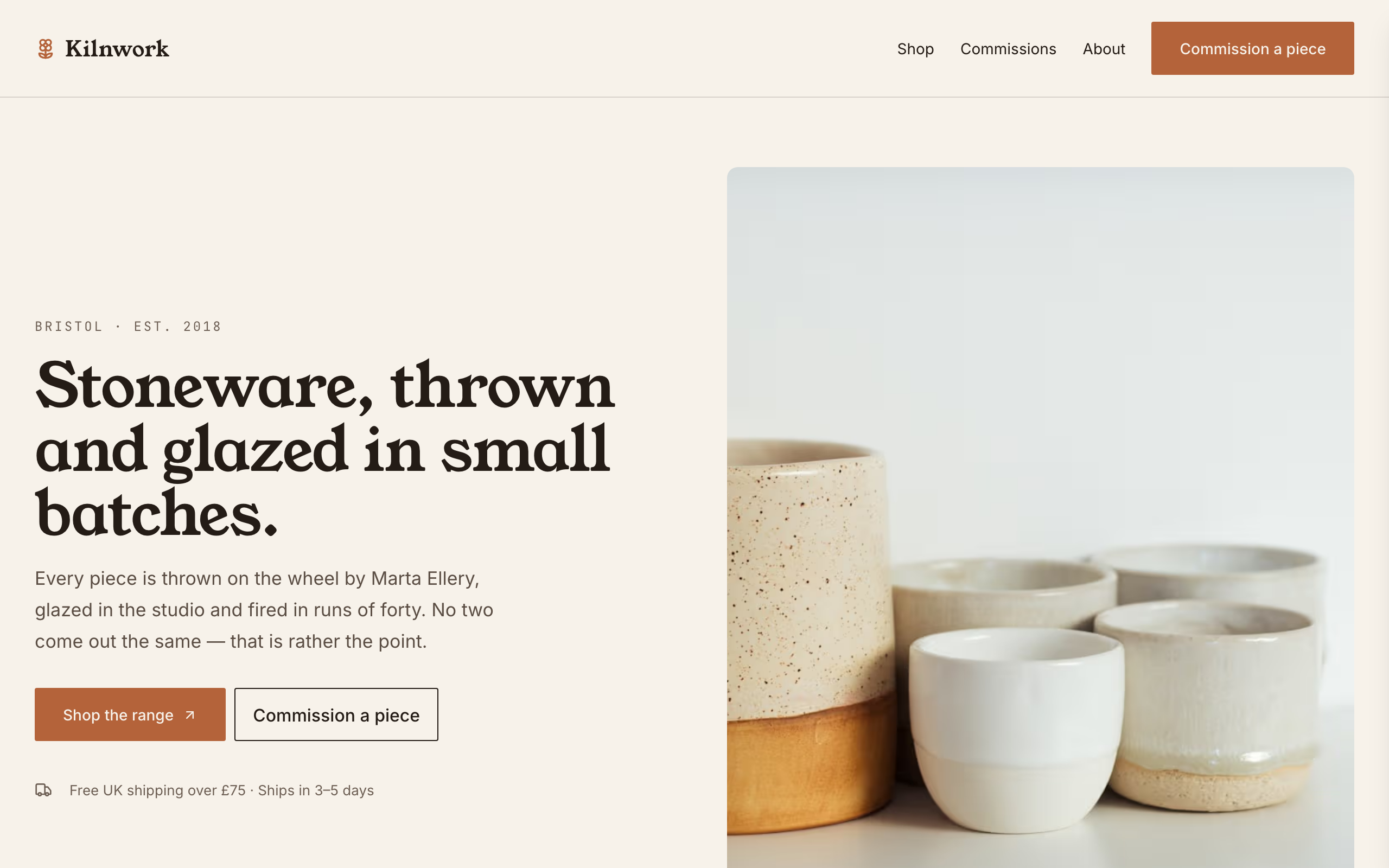
Catalogue-first shop for a maker who sells physical work — ceramics, jewellery, candles, small-batch food. Warm clay palette on oatmeal, Young Serif display over Inter. A product collection with one Stripe payment link per item drives the shop; a separate commissions page carries the made-to-order enquiry form. Built for the maker who has a stocked range AND takes custom orders, which is the shape most small studios actually trade in. Distinct from cami and pazari (portfolios where the work is the pitch and the conversion is an enquiry) — here the conversion is a purchase.