

Quorum
A website template for a candidate running for local or municipal office
Quorum is for one job: a candidate in a local race who needs a site that states a position and collects volunteers. The page is a sequence of declarations — a small crimson label, then one sentence set large enough to read as a banner — broken up by photographic bands so the rhythm never settles into stacked cards. Both of the things that grow during a campaign are collections: issues get real position pages instead of dead links, and endorsements get their own roster and detail pages. Every persona, place, figure and endorsement in the starter content is invented and listed in the launch checklist, because publishing an endorsement you do not have is the one mistake this archetype cannot afford.
Who Quorum is for
Built for these, and tested against them.
- Candidates for city or county council
- School board and municipal races
- Ballot-measure and advocacy campaigns
- Union leadership candidates
- Any campaign that needs positions published, not just a slogan
What’s included
Everything below ships with the template, already filled in.
- Pages
- 5 pages, written and laid out
- Grows with you
- 4 issue entries at /issues/, 8 endorsement entries at /endorsements/ — add one and its index and detail page both update
- Enquiries
- A working form — messages land in your Sitelas inbox
- Type
- Bricolage Grotesque and Inter · light theme
- Everywhere
- Built and checked at phone, tablet and desktop widths
- Yours to change
- Every colour, word and photograph — in the editor or by asking an AI agent
When to pick something else
Quorum is the wrong template for these. Where there is a better one, it is linked.
Free to use · No credit card required
- 1Opens in the editor with the starter content in place
- 2Change the words and pictures to yours
- 3Publish to a sitelas.com address, or your own domain
Key Highlights
Questions about Quorum
Can I change how Quorum looks?
All of it. Colours, type, spacing, photographs and every word are yours to edit — in the visual editor, or by asking an AI agent to do it for you. Nothing is locked.
Do I need to know how to code to use Quorum?
No. You edit the page by clicking the thing you want to change. There is no code to write and nothing to install.
Can I add more issue entries later?
Yes — that is what the issue collection is for. Adding one from the editor creates its own page at /issues/ and updates the index automatically. You are not editing a list by hand.
What does Quorum cost?
Nothing to start, and there is no trial clock. A free site runs on a sitelas.com address; Pro is $9 a month per site when you want your own domain, analytics and more room.
Can I use my own domain?
Yes, on Pro. Point your domain at the site and SSL is issued automatically — there is no certificate to buy or renew.
Make Quorum yours
It opens in the editor with every page already written. Change what you want, publish when it reads like you.
Free to use · No credit card required
Related Templates
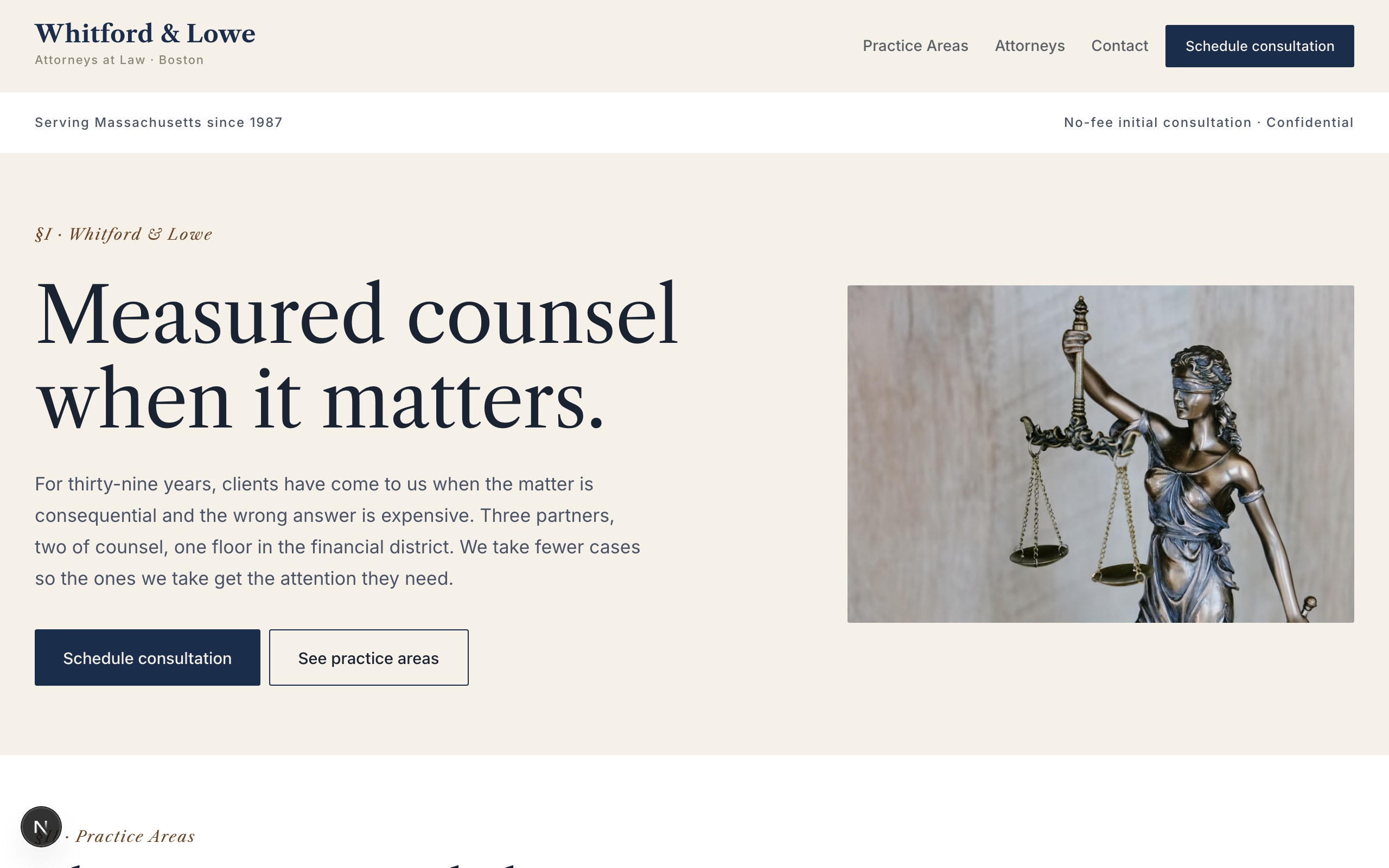
Whitford
Boutique law firm template. Oxford navy with walnut accent on aged cream — authority without BigLaw gloss. Libre Caslon Text display, Inter body, uppercase tracked labels. Roman numerals (§I / §II / §III) segment the home page. Practice areas and attorneys are collections with their own detail pages, so adding a partner or a practice area is one edit, not four. No commerce primitives — pure professional services: contact form (not booking-form) with confidentiality notice, outcomes strip, and the three notice pages a firm needs before it can publish.
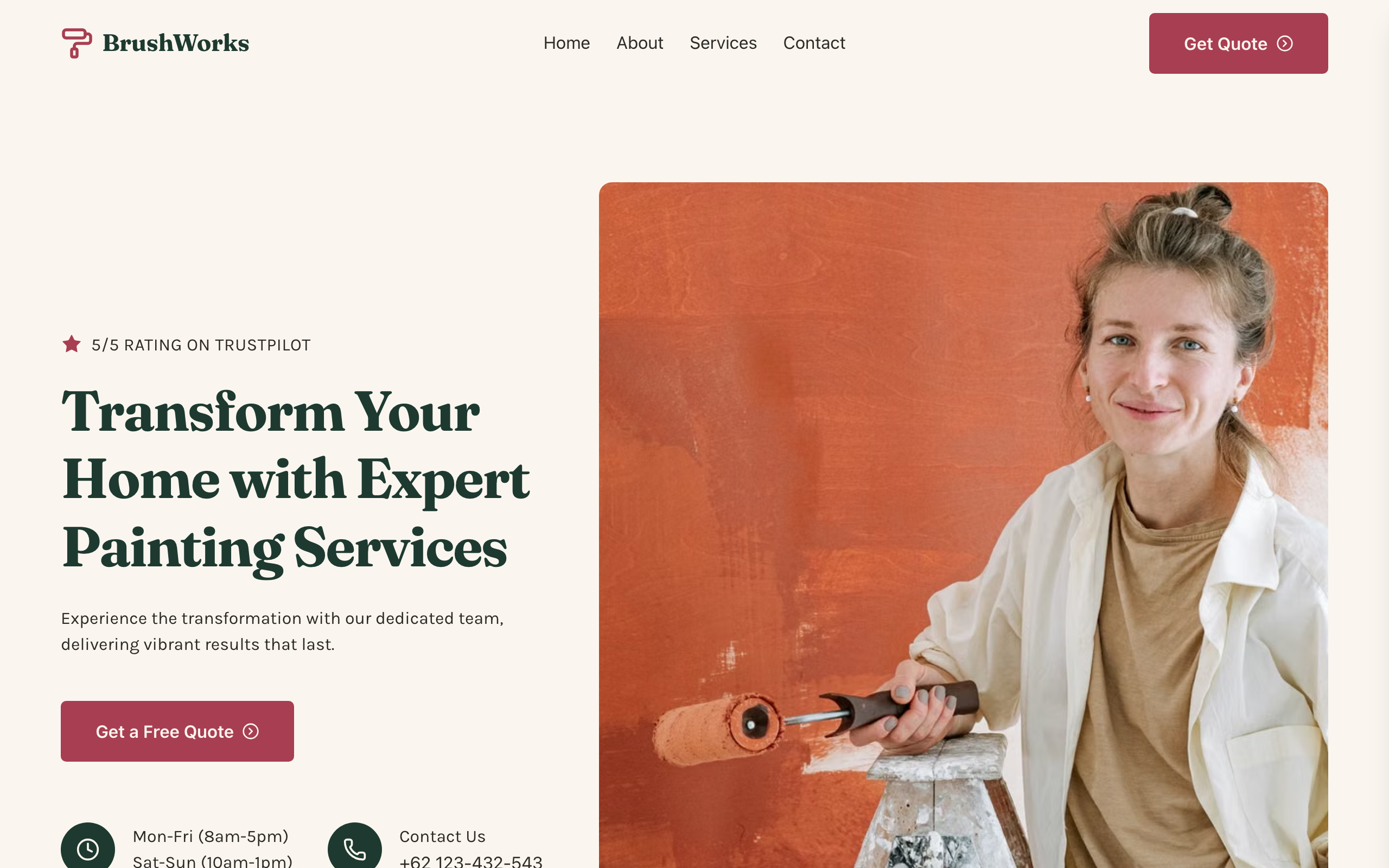
Brushline
For a painting and decorating firm selling residential work to homeowners. Every band change on the page is a rolled curve rather than a straight rule — a hand-drawn wave carries plaster into deep pine at the fold, opens and closes the dark band on both pages that carry one, and opens the closing photograph at the foot of every page. Fraunces over Karla, a warm plaster ground with one raspberry-clay accent spent only on the quote, service cards set at three different heights instead of sitting level, and a five-tile project mosaic in two asymmetric bands. Four pages: home, the firm and its people, four named services, and a contact form that says how long a reply takes. Distinct from ironclad (heavier construction contractor, square edges, sells by tender) and mainstay (a one-person handyman, no crew and no gallery).
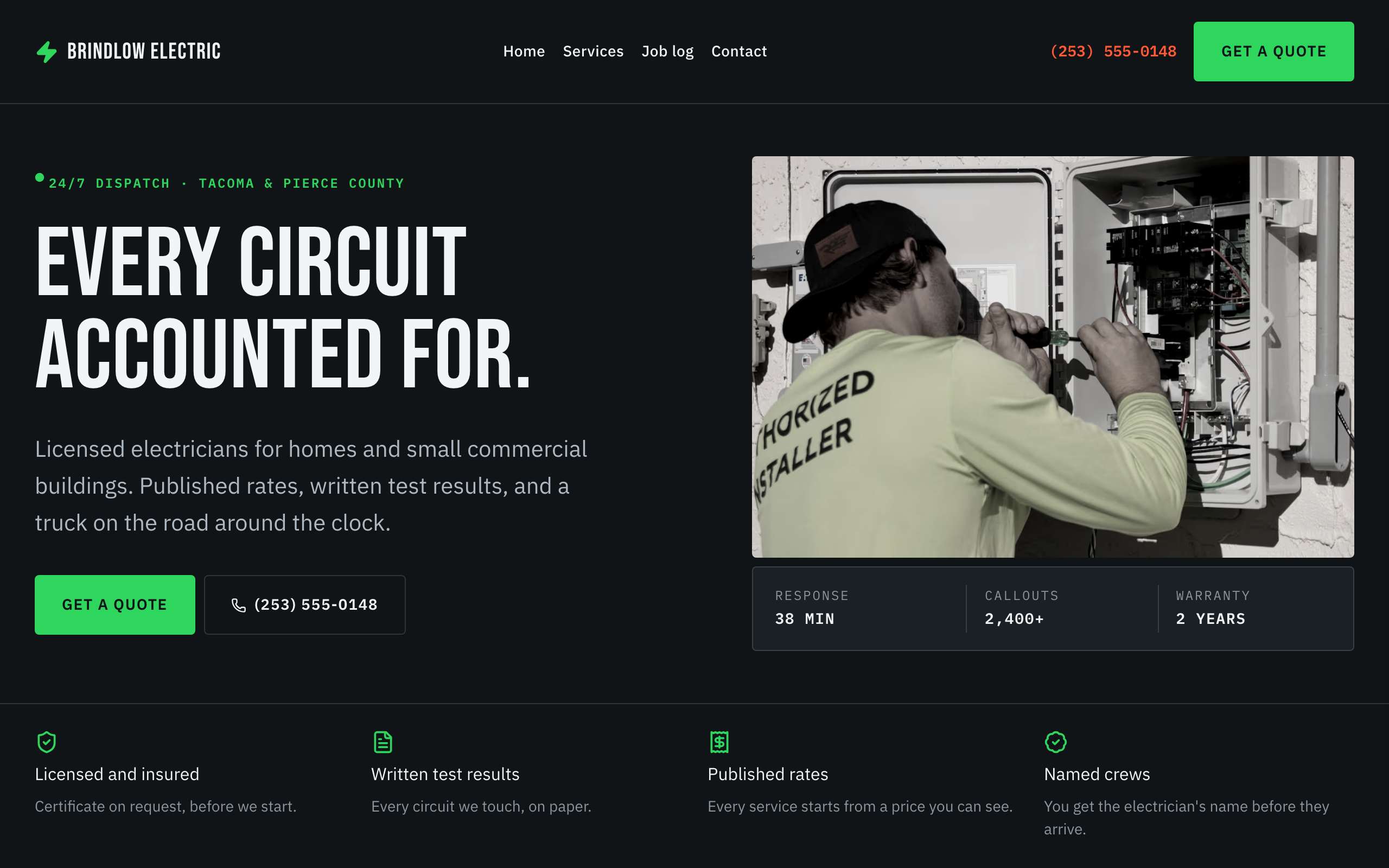
Busbar
Dark, technical template for a licensed electrician or utility trade running emergency call-outs alongside booked work. Services are laid out as a numbered circuit rail with published starting rates, a 24/7 dispatch band carries the phone number, and a collection-backed job log publishes real work with the location, time on site and price.