Plumbing Website Design: What Gets a Plumber the Call
What good plumbing website design puts on the page: the emergency number, license, a page per service, prices, offers and your towns. Then how to build one and change it by asking Claude.

Usman Haider
Water is coming through the kitchen ceiling. The homeowner grabs a phone, searches "emergency plumber", and opens two or three sites. They call the one with a number they can tap, a license and their town on the first screen. Good plumbing website design is mostly that.
The rest is keeping the site true. Plumbing sites go stale easily: last winter's offer, an old phone number, a service you stopped doing. So I'll start with the part most guides skip, changing the site, then go through what to put on it.
Keeping a plumbing website current takes one sentence
I built a site for a made-up plumber, Kettle Creek Plumbing in Tulsa, Oklahoma (the build is further down). The template came with four sample offers. I replaced them with one real one by asking Claude:
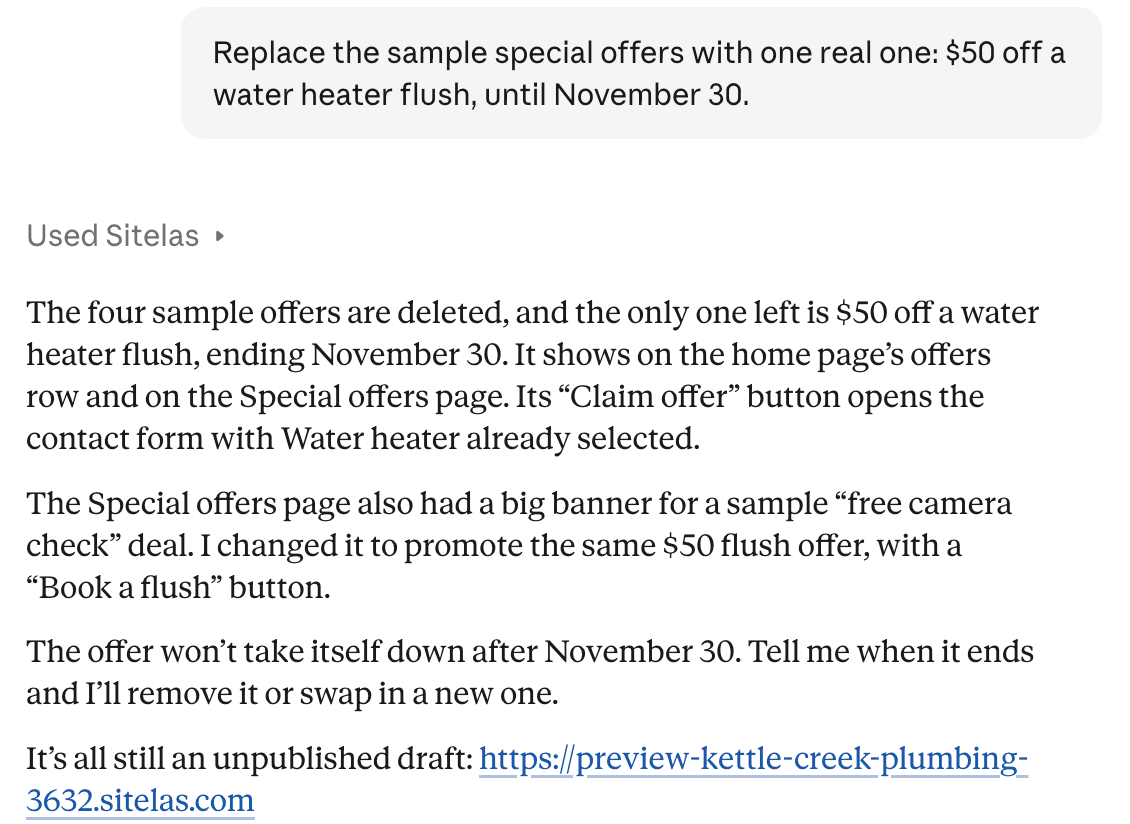
Claude also said the offer won't take itself down after November 30. I'll need to tell it when the offer ends. Here is the offer on a phone:
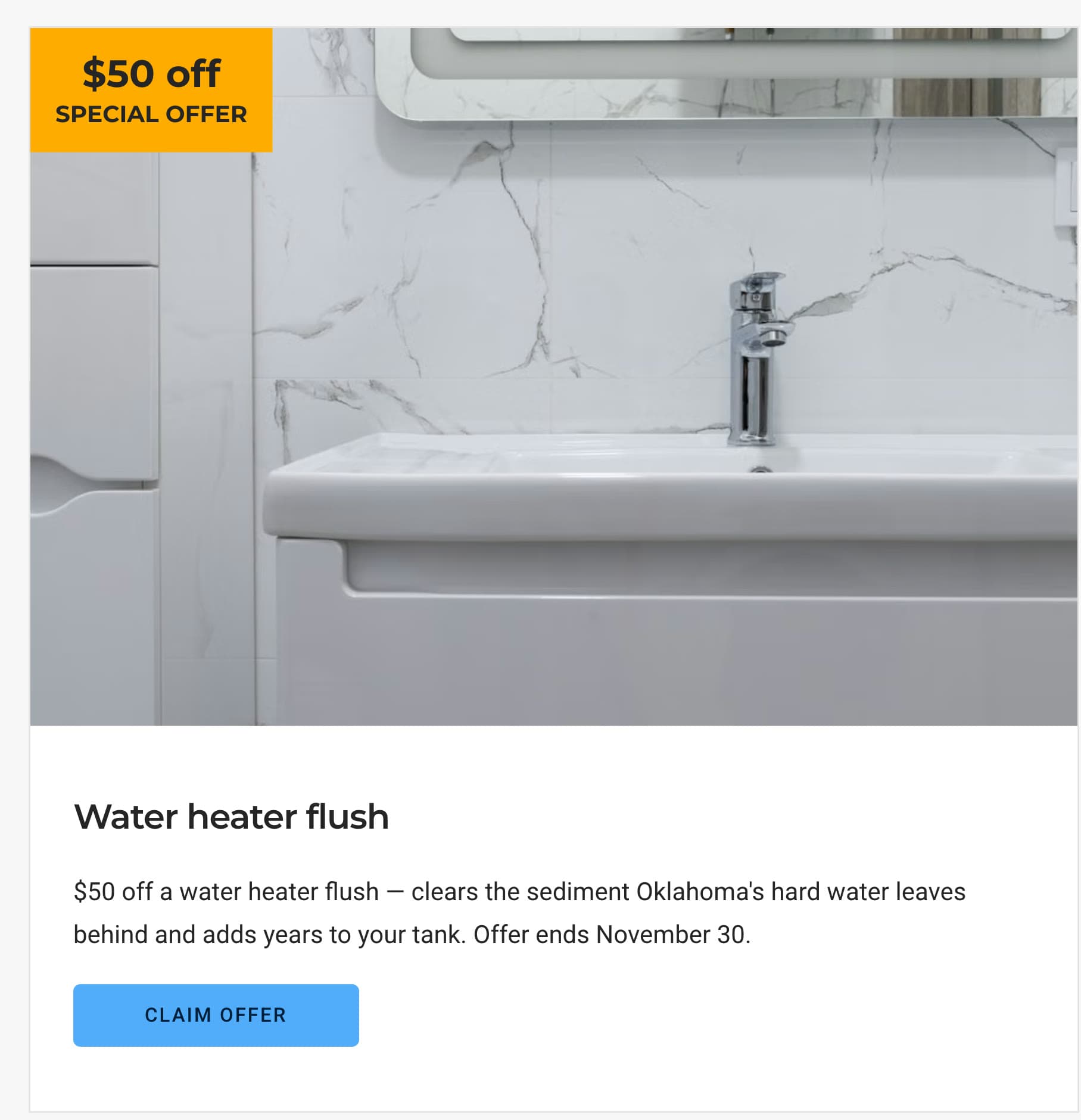
The photo is still the template's bathroom shot. A real company would ask Claude to swap in a photo of its own water heater work. Nothing goes live until you say "publish it".
What makes good plumbing website design
The emergency number, on every screen
Put the phone number in the header so it stays on screen as people scroll. Make it dial with one tap. If you answer around the clock, say "24/7" next to it. A homeowner standing in water won't look for a contact page.
What to do before you arrive
Tell callers what to do while they wait. Shut off the main water valve. It is usually near the meter, or in the basement or crawl space. If the water heater is leaking, switch off its power or gas. A short emergency page like this calms a panicked caller and shows you know the job.
License, insurance and how long you've been around
Your state or city likely licenses plumbers. Show your license number near the top and in the footer, and say you're insured. "Family-run since 2012" does more for trust than any slogan.
A page for each service
Drain cleaning, water heaters, leak detection, sewer lines, repiping, fixtures. Give each one its own page. Say what the job involves, how long it usually takes, and what affects the price. Someone searching "tankless water heater Broken Arrow" should land on the page about exactly that.
Prices, or at least a starting point
Many homeowners worry about the bill first. A "from" price, your service-call fee, or a rough price calculator filters out mismatched calls. Say plainly that the final price comes after you've seen the job.
Offers that are real, with an end date
A seasonal offer gives people a reason to book planned work, like a water heater flush in the fall. Put the end date on it, and take it down when it ends.
Your towns, by name
"Tulsa, Broken Arrow, Jenks, Bixby and Owasso" reassures more than "and surrounding areas". If you add a page per town, say something true about each one. The same page with the name swapped helps nobody.
Your truck, your face and your recent jobs
People are letting a stranger into their home. Show your truck, the owner and the crew, with a short team page. Add a recent-jobs page: the town, the problem and what you did, with your own photos.
Reviews and a short form
Link reviews to where they came from, such as your Google profile, rather than pasting them in. If you do commercial work too, give it its own page and form. Keep the home quote form short: name, phone, town, the problem and a box for details.
Plumber website design mistakes to avoid
- A slow home page. Most visitors are on a phone, often in a hurry.
- An offer that expired months ago. It tells people nobody minds the site.
- One "Services" page listing everything. It can't match ten different searches.
- Stock photos. They make you look like every other plumber in town.
- A form nobody checks. Test it, and every phone link, after each change.
Building one by asking Claude
I added Sitelas to Claude and sent one message with the business details. The message said family-run since 2012, licensed and insured, a 24/7 line, six services and five towns.
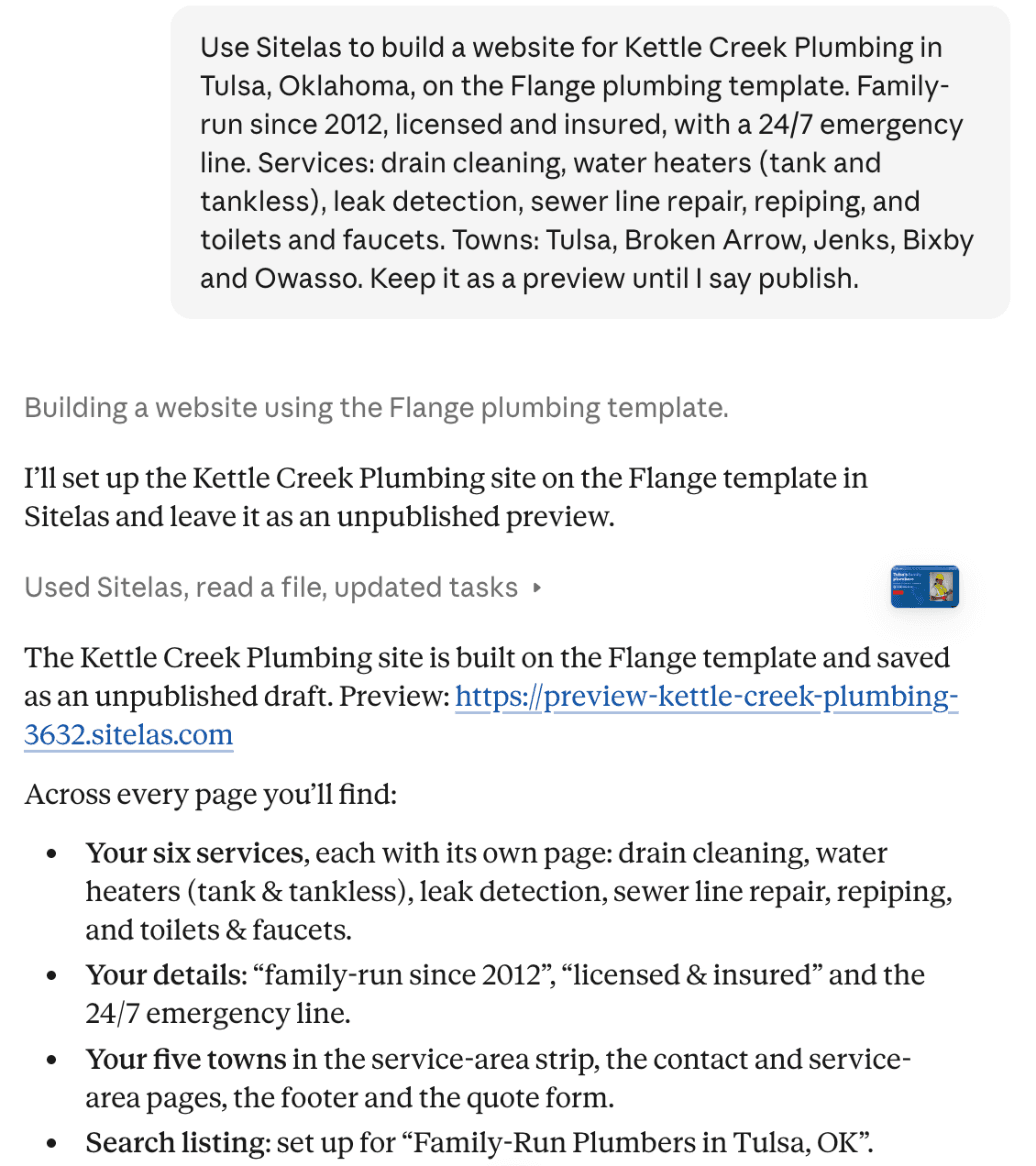
Claude built it from Sitelas's plumbing template, Flange, as a private preview. It replaced the template's made-up reviews and owner details rather than leave invented names on the site. Then it listed what still needed real details: the phone number, team photos, prices and sample projects.
The first screen on a phone has the name, the trust lines, a tap-to-call number and a quote button:
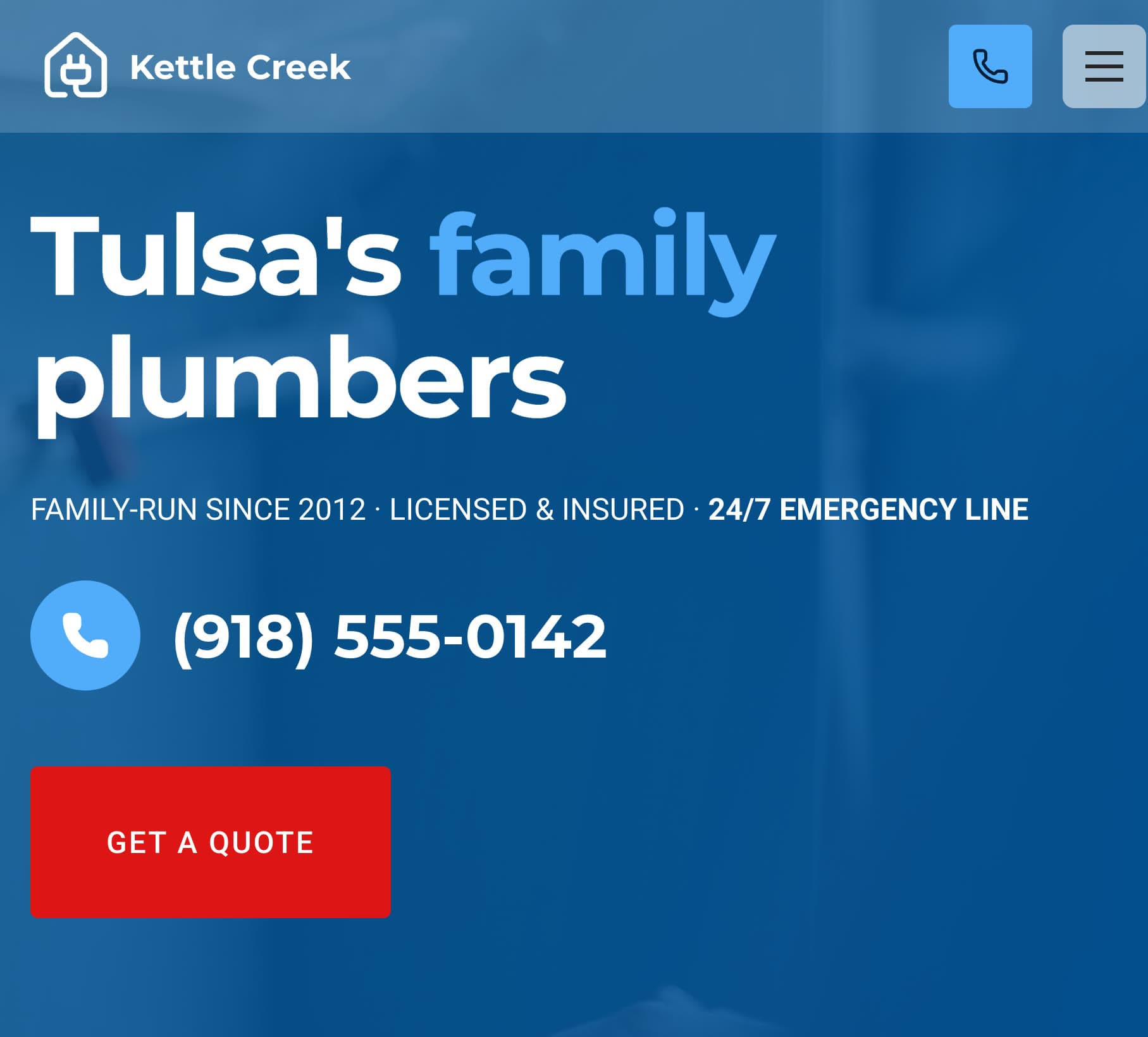
A real company would add its license number there too. Later changes, like a new service or a holiday notice, are one more message. To fix a word yourself, there's an editor where you click and type on the page.
What it can't do
Sitelas builds and runs the website. It doesn't answer calls, dispatch jobs, book appointments into a calendar or send invoices. Those stay with your phone and field service software. Quote requests land in a Sitelas inbox. The Free plan reads 5 a month, which a busy plumber will pass. Pro reads up to 500 and adds a custom domain, for $9 a month per site.
Getting found on Google is separate work: your Google Business Profile, reviews and listings. Local SEO for contractors covers it, and our Google Business Profile guide walks through the profile itself.
Questions people ask
What should a plumbing website include? A tap-to-call number on every screen, your license and insurance, and a page per service. Add the towns you serve, starting prices, real reviews and photos, and a short quote form.
How much does a plumbing website cost? A 2026 cost guide cited by simPRO puts do-it-yourself builders at $0 to $50 a month. A freelancer costs $500 to $3,000. A custom designer runs $2,500 to $8,000, and agencies start around $10,000. On Sitelas, Pro is $9 a month per site, or $90 a year.
Should a plumber show prices on the website? Starting prices help. A "from" price on common jobs, like a water heater flush, sets expectations before the call. Exact quotes still need a visit, so say that too.
Do plumbers need a website if they have a Google profile? The profile gets you into the map. The website is where people check you before calling, and where each service can have its own page. Most plumbers do best with both.
Try it
Copy this into a new Claude or ChatGPT chat after adding Sitelas. Swap in your own details first.
Use Sitelas to build a website for my plumbing company, [name] in [town],
on the Flange plumbing template. Licensed and insured, [license number].
Emergency line: [phone, and hours]. Towns we serve: [list].
Services with starting prices: [service, from $X], ...
Keep it as a preview until I say publish.
- Add to Claude: Sitelas in Claude's connector directory
- Add to ChatGPT: Sitelas in ChatGPT
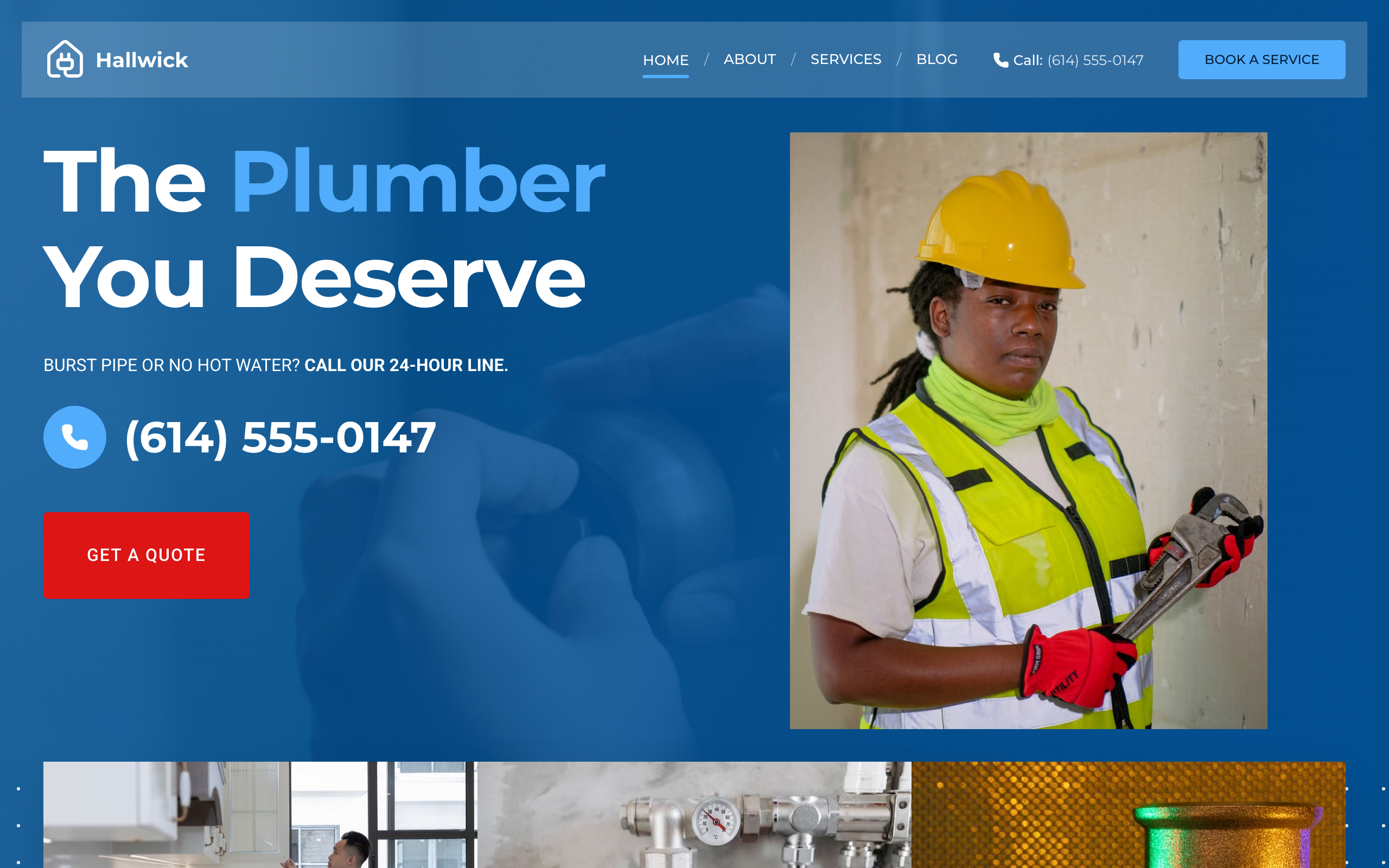
- See the design we used: the Flange plumbing template
Templates to start from
Build this with a ready-made design, then change anything.

Usman Haider
Founder of Sitelas — the website builder for AI agents.