

Patchbay
A website template for an interview or documentary podcast with a back catalogue worth browsing
Most podcast templates render episodes as picture cards, which is a shape borrowed from blogs and which stops working at about the twentieth episode. Patchbay renders them as ruled rows with a fixed-width rail on the left carrying the season, the episode number and the run time in monospace. A visitor can scan forty of them. A grid of forty cards is a wall.
Who Patchbay is for
Built for these, and tested against them.
- An interview or documentary podcast with a back catalogue worth browsing
- A show whose listeners arrive from a search or a link rather than the front page
- Anyone who publishes on a cadence and wants the archive to stay scannable at fifty episodes
- A small team — two hosts and a producer — rather than a network
- Shows that would rather be followed in an app than watched on a site
What’s included
Everything below ships with the template, already filled in.
- Pages
- 5 pages, written and laid out
- Grows with you
- 12 episode entries at /episodes/ — add one and its index and detail page both update
- Enquiries
- A working form — messages land in your Sitelas inbox
- Type
- Be Vietnam Pro and Work Sans · light theme
- Everywhere
- Built and checked at phone, tablet and desktop widths
- Yours to change
- Every colour, word and photograph — in the editor or by asking an AI agent
About This Template
The rack, not the grid
The newest episode is the first thing on the page
It sits in a full-bleed cyan bar that overlaps the bottom of the hero, so the thing a visitor came for is above the fold rather than three sections down. Every episode page carries a player under its masthead: add the audio file to an episode and the player appears, with no embed code to paste.
Built to grow
Episodes are a collection. Twelve ship with the template; adding the thirteenth is one form in the editor and it appears on the home page, in the archive, in the search box and in the related strip without anything being edited.
Honest by construction
Guests are described by what they do and the sector they do it in, never by a named employer, so nothing in the starter content asserts a relationship with a real organisation.
When to pick something else
Patchbay is the wrong template for these. Where there is a better one, it is linked.
- A single-page promo for one show with no archive to browse — try Airwave or Rivet
- A warm, editorial personal newsletter
- A video-first channel: the player here is audio and the layout assumes it
- A portfolio of client work rather than a run of published episodes — try Base-folio
- Selling a course or a paid membership — there is no payment link anywhere in this template
- A written blog with no audio at all — try Narrative or Daybook
Free to use · No credit card required
- 1Opens in the editor with the starter content in place
- 2Change the words and pictures to yours
- 3Publish to a sitelas.com address, or your own domain
Key Highlights
Questions about Patchbay
Can I change how Patchbay looks?
All of it. Colours, type, spacing, photographs and every word are yours to edit — in the visual editor, or by asking an AI agent to do it for you. Nothing is locked.
Do I need to know how to code to use Patchbay?
No. You edit the page by clicking the thing you want to change. There is no code to write and nothing to install.
Can I add more episode entries later?
Yes — that is what the episode collection is for. Adding one from the editor creates its own page at /episodes/ and updates the index automatically. You are not editing a list by hand.
What does Patchbay cost?
Nothing to start, and there is no trial clock. A free site runs on a sitelas.com address; Pro is $9 a month per site when you want your own domain, analytics and more room.
Can I use my own domain?
Yes, on Pro. Point your domain at the site and SSL is issued automatically — there is no certificate to buy or renew.
Make Patchbay yours
It opens in the editor with every page already written. Change what you want, publish when it reads like you.
Free to use · No credit card required
Related Templates
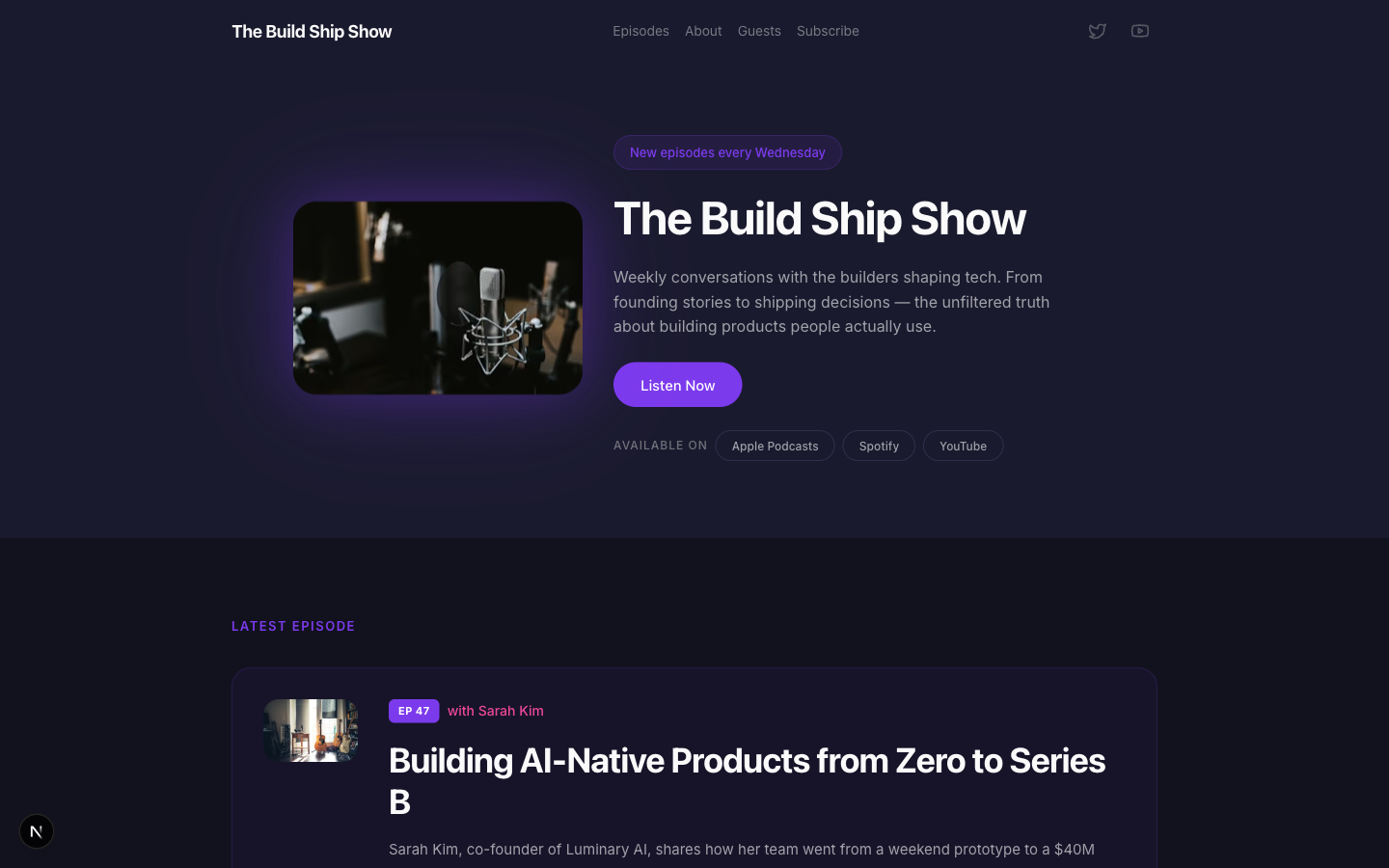
Airwave
A bold podcast and creator page with dark charcoal tones, electric purple accents, episode listings, guest spotlights, and platform subscription links — designed for shows that want to look as good as they sound.
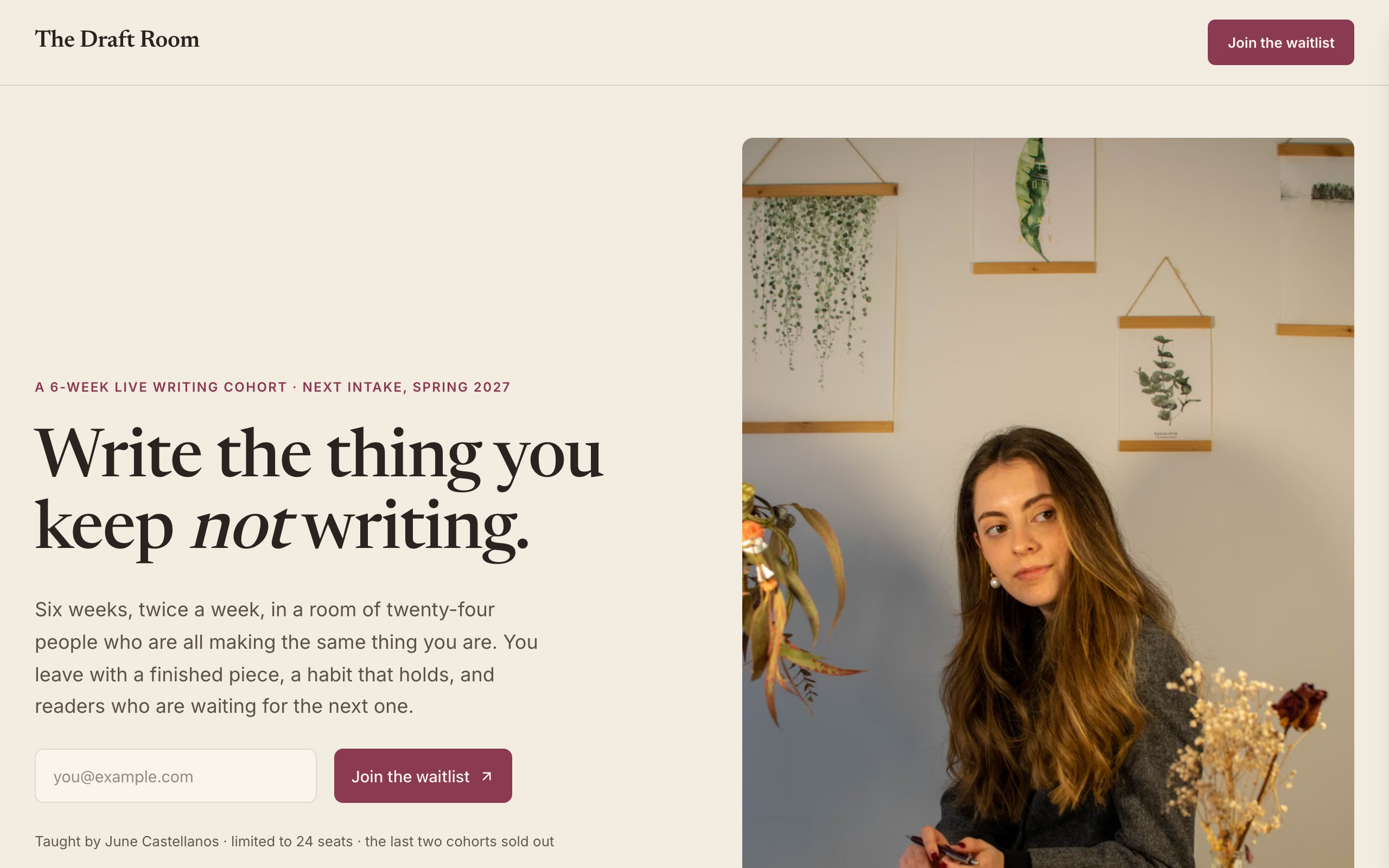
Atelier
Waitlist for a cohort-based COURSE — the first education/creator-course waitlist in the catalog. Instructor-led register: warm paper, ink, a single plum accent, Newsreader (a bookish reading serif) against Inter — warm and personal, deliberately NOT the cream-serif-terracotta default. Course-native signatures no product waitlist has: an instructor front-and-centre with a portrait (the teacher is the draw), a 'cohort at a glance' details card (format / duration / commitment / cohort size / next date / investment), a week-by-week syllabus, past-cohort testimonials with star ratings, and a 'join the waitlist for the next cohort' form. Single-page: split hero (waitlist form + instructor portrait) → cohort details card → six-week syllabus → who's teaching → testimonials → waitlist-momentum band → FAQ → waitlist CTA → footer. Conversion is newsletter-signup (join the next-cohort waitlist). Demo persona is 'The Draft Room', a 6-week live writing cohort taught by June Castellanos, but the design suits any cohort course or bootcamp. Distinct from every software / product / real-estate waitlist.
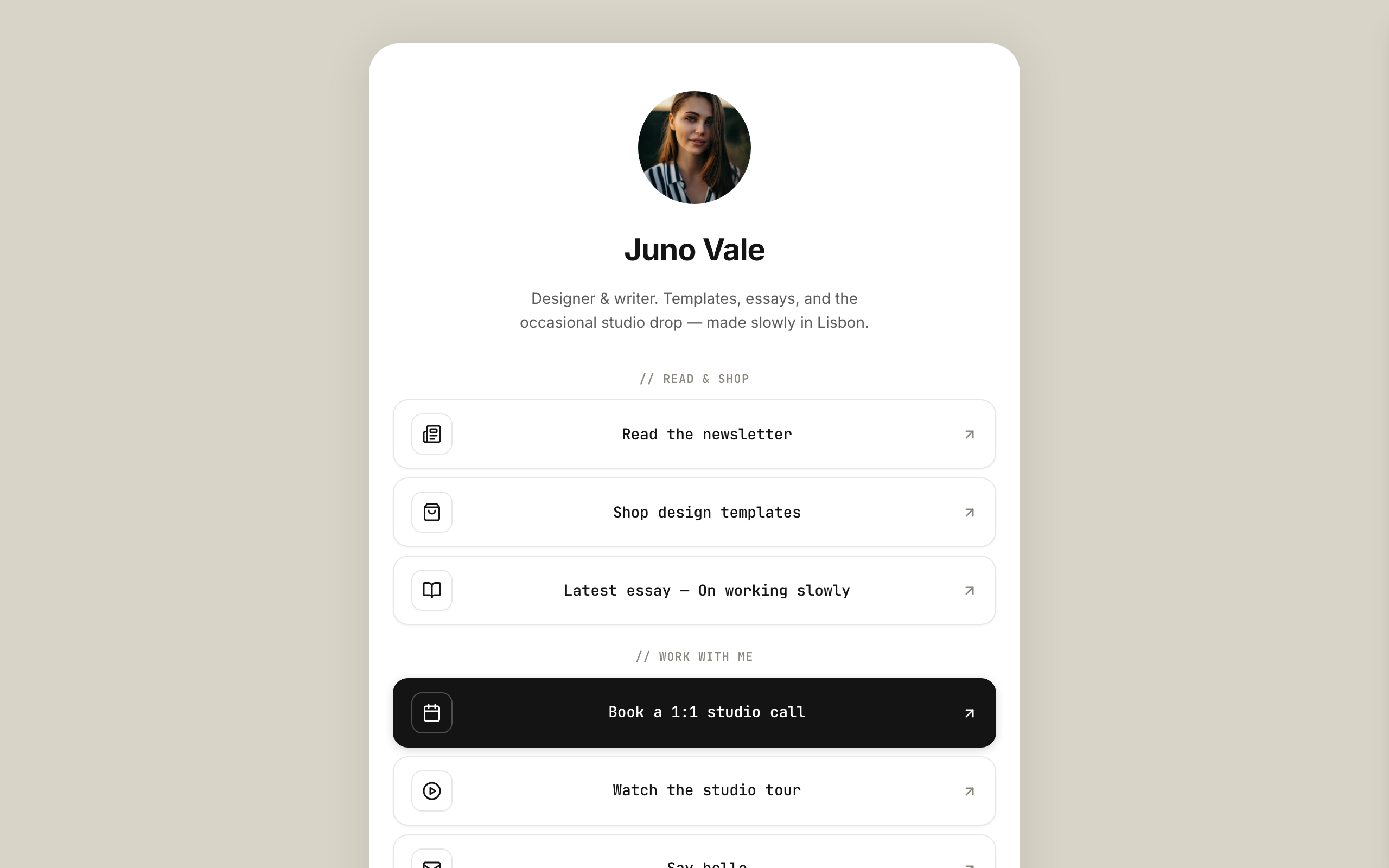
Halo
Modernist-minimal link-in-bio for multidisciplinary creators — a faithful Linktree profile-card. A warm-grey page gutter with one elevated, fully-rounded ~600px centered card that holds everything; no header, no footer. White card, ink type, a single muted-clay accent, Inter + JetBrains Mono. Inside the card, top to bottom: circular avatar → name → one-line bio → vertical stack of outlined link buttons (leading icon tile + trailing arrow) → social-icon row, then a stacked shop strip with Stripe buy buttons, a short about block, and the stacked newsletter capture the card ends on. The link buttons ARE the conversion (subscribe-platform).